
You Don’t Have a Sustainability Problem—You Have a Decision Problem
Most organizations already know what they should do on sustainability. The real challenge is whether their decision systems are capable of doing it.
6/1/20262 min read
For years, companies have invested heavily in sustainability strategies, ESG frameworks, climate commitments, circular economy initiatives, and reporting systems.
Yet despite all of this activity, progress often remains slow, fragmented, or inconsistent.
Targets are announced.
Roadmaps are created.
Reports are published.
But inside the organization, operational decisions continue following the same logic as before.
And that is the real issue.
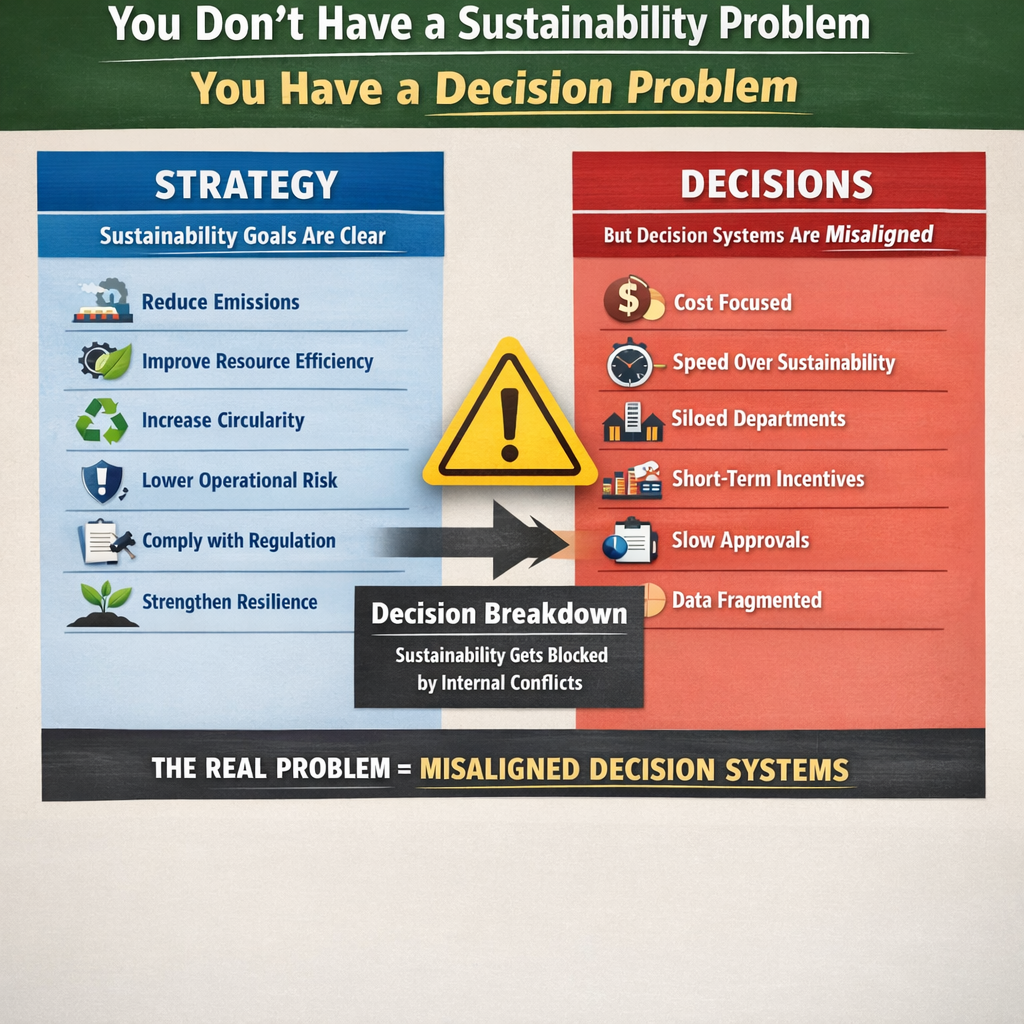
Most companies do not actually have a sustainability problem.
They have a decision problem.
Sustainability Is Not Failing at the Strategy Level
In many organizations, sustainability strategy is already relatively clear.
The objectives are usually known:
Reduce emissions
Improve resource efficiency
Increase circularity
Lower operational risk
Comply with regulation
Strengthen long-term resilience
The problem is not awareness.
The problem is translation.
Because strategy only matters if it changes decisions:
investment decisions
procurement decisions
engineering decisions
operational decisions
product design decisions
supply-chain decisions
prioritization decisions
And in most companies, sustainability still enters too late in those processes.
The Invisible System Blocking Sustainability
Organizations often assume sustainability fails because:
employees resist change
budgets are limited
regulation is unclear
technology is immature
Those factors matter.
But internally, the biggest obstacle is usually much simpler:
The organization’s decision architecture was never designed to optimize sustainability outcomes.
It was designed to optimize:
short-term cost
operational speed
quarterly performance
risk avoidance
production continuity
silo efficiency
So even when sustainability becomes a corporate objective, the underlying decision system keeps pushing the organization in another direction.
The result is structural contradiction.
Sustainability Loses When KPIs Conflict
This becomes especially visible when incentives collide.
For example:
Procurement is rewarded for lowest cost
Operations are rewarded for uptime
Finance is rewarded for short-term margins
Sustainability teams are rewarded for emissions reduction
Each department may perform successfully according to its own KPIs.
Yet collectively, the organization fails to move sustainably.
Why?
Because sustainability becomes subordinate whenever trade-offs appear.
And trade-offs appear constantly.
Without aligned decision structures, sustainability becomes:
delayed
diluted
deprioritized
operationally inconvenient
Not intentionally.
Systemically.
Most Sustainability Bottlenecks Are Decision Bottlenecks
This is why many sustainability initiatives stall during implementation.
Not because the strategy was wrong.
But because the organization cannot operationalize decisions consistently across functions.
Typical bottlenecks include:
unclear decision ownership
fragmented governance
slow approval chains
disconnected ESG data
conflicting departmental incentives
lack of operational integration
sustainability teams without decision authority
In many cases, sustainability teams become advisory functions with limited influence over actual operational decisions.
That creates frustration across the organization:
leadership sees slow progress
operational teams see additional complexity
sustainability teams see limited execution capability
Everyone feels the friction.
Few identify the root cause.
Sustainability Is a Systems Design Challenge
The organizations making real progress are not simply adding more sustainability initiatives.
They are redesigning how decisions are made.
They recognize that sustainability must become embedded into:
investment governance
engineering reviews
procurement criteria
risk assessment
operational planning
innovation pipelines
performance metrics
This is not a communications exercise.
It is organizational systems design.
The question is no longer:
“Do we care about sustainability?”
The real question is:
“Can our decision system consistently produce sustainable outcomes under operational pressure?”
Those are very different things.
The Shift Companies Need to Make
Many organizations continue treating sustainability as:
a reporting exercise
a compliance function
a communication layer
a parallel initiative
But sustainability is increasingly becoming a core operational capability.
That means organizations must shift from:
sustainability messaging → decision integration
ESG visibility → operational execution
isolated initiatives → systemic alignment
sustainability departments → sustainability-enabled decision systems
This is where transformation actually happens.
Not in the strategy document.
In the everyday decisions shaping products, operations, investments, supply chains, and engineering priorities.
Final Thought
If sustainability progress inside your organization feels slower than expected, the problem may not be your ambition.
It may be your decision architecture.
Because organizations rarely fail sustainability due to lack of intent.
They fail because their systems continue rewarding decisions that produce unsustainable outcomes.
And until decision-making changes, sustainability will always struggle to move from strategy into reality.