Why Sustainability Transformations Stall After the First Success
Early wins create momentum—but they can also create illusion. What looks like progress often prevents the transformation that truly matters.
4/1/20263 min read
The Success That Stops Progress
Most sustainability transformations don’t fail at the beginning.
They stall after the first success.
A pilot reduces emissions.
A circular initiative improves recycling rates.
A product redesign delivers measurable impact.
The organization celebrates—and then slows down.
Not because the ambition disappears.
But because early success creates a dangerous illusion:
that the system is already working.
The Pilot Success Trap
Early sustainability wins are powerful. They demonstrate feasibility, build confidence, and create internal momentum.
But they also create unintended consequences:
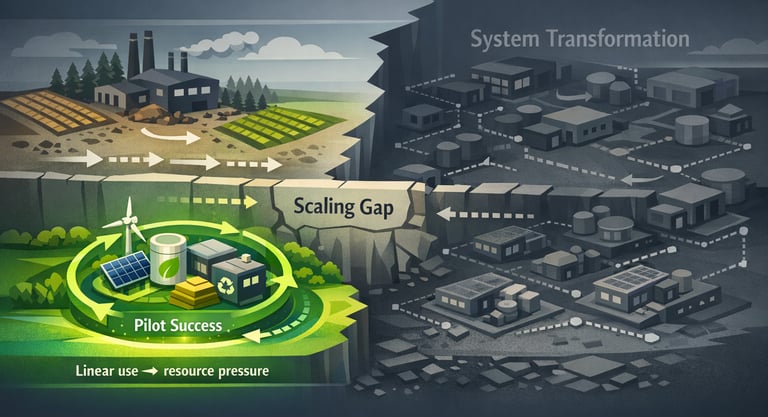
Success becomes localized instead of systemic
Efforts remain confined to one team or business unit
Scaling is assumed, not designed
Leadership shifts attention to the next priority
What started as a breakthrough becomes an exception.
The organization learns how to succeed once—not how to repeat success consistently.
Incrementalism Replaces Transformation
After the first visible improvement, organizations often shift into incremental mode.
Instead of redesigning systems, they:
optimize existing processes
expand small initiatives
report progress through isolated metrics
This creates activity—but not transformation.
Incremental improvements are easier to approve, easier to communicate, and less disruptive to existing structures.
But sustainability challenges—climate, circularity, resource constraints—are not incremental problems.
They require structural change.
Why Scaling Is Harder Than Starting
Scaling sustainability is not a technical challenge. It is an organizational one.
What works in a pilot environment often breaks at scale because:
governance is unclear
ownership is fragmented
incentives are misaligned
processes are not designed for replication
In pilots, teams operate with flexibility, attention, and temporary alignment.
At scale, they face:
competing priorities
budget constraints
operational complexity
Without redesigning how decisions are made, success cannot scale.
The Comfort of Visible Progress
Organizations are drawn to what they can measure and communicate.
Early successes provide:
clear metrics
positive narratives
external recognition
This creates a subtle bias:
visible progress is mistaken for meaningful progress.
Meanwhile, deeper structural changes—those that enable long-term transformation—remain unaddressed because they are:
harder to measure
slower to show results
more disruptive to existing systems
The Governance Gap Behind the Stall
The real reason sustainability transformations stall is not lack of ideas.
It is lack of governance.
After the first success, organizations rarely redefine:
who owns sustainability decisions at scale
how trade-offs are resolved across functions
how sustainability is embedded into investment logic
how incentives support long-term outcomes
Without this, sustainability remains:
project-based
dependent on champions
vulnerable to shifting priorities
Transformation requires moving from initiative to infrastructure.
From Success to System
Organizations that move beyond the first success do something fundamentally different.
They treat early wins not as endpoints—but as signals to redesign the system.
They:
translate pilot learnings into standardized processes
embed sustainability into stage gates and decision frameworks
align incentives across functions
assign clear ownership for scaling outcomes
integrate sustainability into capital allocation and strategy
In these organizations, success is not repeated by chance.
It is reproduced by design.
Europe and Latin America: Same Pattern, Different Context
In Europe, early sustainability successes are often driven by regulation and innovation funding.
But scaling stalls due to:
organizational complexity
fragmented accountability
regulatory overload
In Latin America, early successes often emerge from targeted initiatives or partnerships.
But scaling is constrained by:
resource limitations
infrastructure gaps
competing economic priorities
Different contexts.
Same failure mode.
Success is achieved—but not institutionalized.
The Real Work Begins After the First Win
The first sustainability success is not the hardest part.
It is the most misleading one.
Because it creates the impression that the organization is further along than it actually is.
In reality, the first success only proves one thing:
that transformation is possible.
It does not prove that it is scalable, repeatable, or embedded.
A Final Thought
Sustainability transformations do not stall because organizations fail.
They stall because organizations succeed—too early, and too locally.
The first sustainability success often becomes the reason transformation stops.
The organizations that lead will be those that understand this paradox:
success must trigger system redesign
pilots must evolve into operating models
progress must move from visible to structural
At Abaeco Consultants, this is where we focus:
helping organizations move beyond isolated success—
and build systems where sustainability scales by design.
Because real transformation doesn’t start with the first success.
It starts after it.