
Why Sustainability Trade-Offs Are the Real Competitive Advantage
Every sustainability decision involves a compromise. Leaders win not by avoiding trade-offs, but by mastering them.
4/7/20262 min read
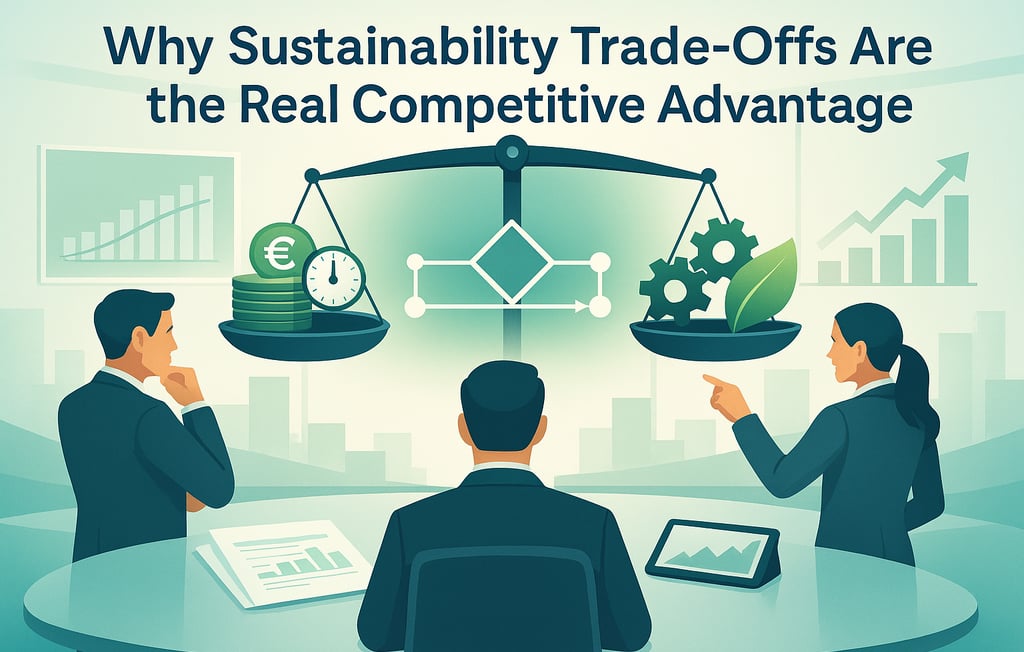
For years, sustainability conversations have focused on ambition, innovation, and responsibility. But in practice, executives know that the real work happens in the tension between competing priorities. Every strategic choice involves a compromise—between cost and impact, short-term results and long-term resilience, efficiency and transformation.
At our firm, we believe a simple but powerful truth:
Sustainability leaders don’t eliminate trade-offs—they make better ones.
And in today’s volatile, resource‑constrained economy, mastering sustainability trade‑offs has become one of the most important competitive advantages a company can build.
The Reality: Trade-Offs Are Inevitable
Businesses often talk about “win‑wins”—and while those do exist, they are not the norm. Real strategic decision-making requires prioritization. Leaders are constantly balancing:
Cost vs. sustainability investments
Speed vs. due diligence
Short-term targets vs. long-term profitability
Innovation vs. operational feasibility
Growth vs. emissions reduction
Trying to avoid these tensions doesn’t make them disappear—it simply delays progress and increases risk. High-performing organizations acknowledge constraints openly and use them as a catalyst for smarter, more intentional choices.
In our work, we consistently see that companies who embrace trade-offs early ultimately move faster, waste less time, and build stronger internal alignment.
The Problem: Most Organizations Hide Their Trade-Offs
Many companies try to present sustainability decisions as costless or effortless. This leads to three recurring issues:
1. Decisions Go Unmade
Teams wait for the mythical solution that satisfies every stakeholder perfectly. Meanwhile, competitors advance.
2. Initiatives Fragment
Departments make isolated choices without a shared logic. The result: duplicated costs, competing priorities, and inconsistent messaging.
3. Leaders Lose Credibility
When trade-offs are not acknowledged openly, employees quickly notice the gaps between sustainability ambition and operational reality.
Avoiding trade-offs doesn’t protect an organization—it weakens it.
The Shift: Turning Trade-Offs Into Strategic Assets
The most competitive companies are not those who magically avoid compromise. They are those who:
Structure trade-offs, instead of reacting to them
Align stakeholders around decision logic
Use transparent frameworks to guide internal debate
Balance ambition and feasibility without losing momentum
Update decisions dynamically as technology, policies, and markets evolve
This is where sustainability moves from being a cost center to a strategic engine.
When trade-offs are made consciously—with data, governance, and clarity—they create coherence across the organization. They accelerate execution. They reduce risk. And they build credibility with investors, regulators, and employees.
Decision Frameworks: The New Competitive Advantage
A good sustainability strategy is no longer enough. What differentiates leaders now is how they decide, not just what they decide.
We help clients build decision frameworks that:
1. Identify the Real Constraints
Most organizations operate with unspoken assumptions. We surface them, quantify them, and test them.
2. Map the Impact Across the Business
A trade-off in one area can generate value in another. The key is understanding cross-functional implications.
3. Prioritize Based on Value, Not Convenience
Simple matrices are replaced with dynamic evaluation tools combining financial, environmental, and operational criteria.
4. Create Repeatable Processes
The goal is not a one-time decision—it’s a decision system that scales.
5. Enable Transparent, Defensible Choices
So leaders can communicate decisions with confidence, both internally and to the market.
In a world where regulations tighten, stakeholder expectations rise, and sustainability is tied to capital access, companies that decide better will lead markets—not follow them.
The Future Belongs to Companies That Master Trade-Offs
Sustainability will only grow more complex. Supply chains will face more scrutiny. Energy transitions will create new dependencies. Climate risks will reshape operating models.
The organizations that win will not be those pretending there is no friction. They will be those who:
Confront constraints honestly
Build strong governance
Make transparent decisions
Optimize long-term value
Act with discipline and intelligence
Mastering trade-offs is not a limitation—it is a leadership capability.
And it is quickly becoming the differentiator that sets true sustainability leaders apart.