
Why Sustainability Strategies Fail in Real Decisions
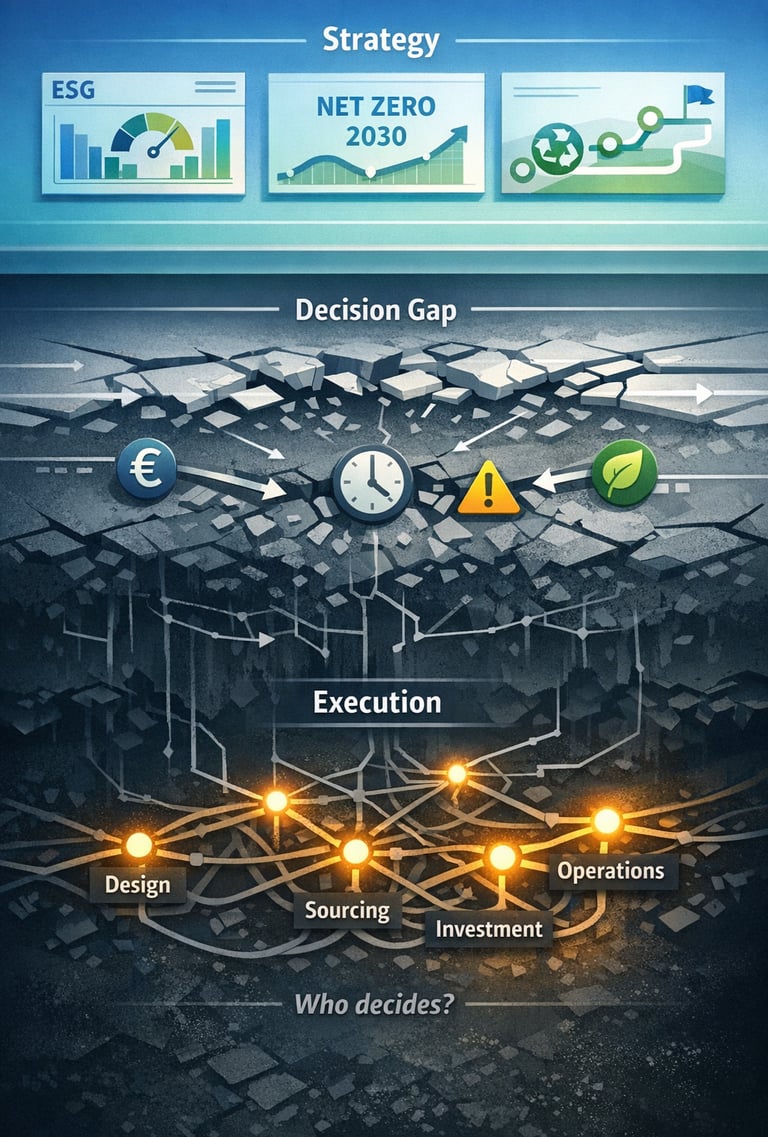
Sustainability doesn’t fail in strategy documents. It fails in the moment decisions are made.
4/21/20262 min read
Organizations today are not lacking sustainability ambition.
They have:
net zero targets
ESG frameworks
circular economy commitments
innovation roadmaps
On paper, everything is aligned.
Yet when real decisions are made—about product design, sourcing, investment, or timelines—
sustainability is often sidelined.
Not because it is irrelevant.
But because it is not built into how decisions actually work.
The Strategy–Execution Illusion
Most sustainability strategies are well-structured, data-driven, and clearly communicated.
They define:
long-term goals
performance indicators
reporting mechanisms
But they rarely define something more critical:
👉 How sustainability should influence real decisions under constraint.
This creates a structural gap.
Strategy speaks in ambition.
Decisions operate under pressure:
cost targets
delivery deadlines
technical feasibility
risk exposure
When these pressures collide, sustainability is expected to “fit in.”
It rarely does.
Where Sustainability Actually Breaks
The failure point is not at the top—or at the bottom.
At the top, direction is clear.
At the operational level, execution is disciplined.
The breakdown happens in between:
👉 the decision layer
This is where:
trade-offs are negotiated
priorities are rebalanced
constraints become real
Typical conflicts include:
cost vs sustainability
speed vs long-term risk
innovation vs compliance
performance vs circularity
These are not edge cases.
They are daily decisions.
Yet in most organizations:
sustainability is present as input
but absent as authority
The Missing Link: Decision Design
Sustainability strategies assume alignment.
But alignment is not a statement—it is a system.
Most organizations have not designed:
who decides when trade-offs arise
when sustainability overrides cost
how conflicts between KPIs are resolved
where escalation should happen
As a result:
decisions default to existing power structures
short-term optimization dominates
sustainability becomes negotiable
Not intentionally. Structurally.
Why Data Doesn’t Fix the Problem
Many organizations respond by investing in:
better ESG data
more detailed reporting
advanced analytics
These improvements increase visibility.
They do not increase influence.
Because the problem is not information.
👉 It is decision authority.
If sustainability data is not embedded into decision gates,
it will be acknowledged—but not acted upon.
When Sustainability Becomes a Justification Tool
Over time, a pattern emerges:
Sustainability is used to:
justify decisions after they are made
support reporting narratives
demonstrate progress externally
But not to:
shape decisions before they are locked in
This is why organizations can report progress
while simultaneously missing their most important opportunities.
What High-Performing Organizations Do Differently
Organizations that succeed do not rely on alignment—they design it.
They:
embed sustainability criteria into decision processes
define clear decision rights
align KPIs across functions
create escalation paths for unresolved trade-offs
integrate sustainability into early design stages
In these systems:
sustainability is not an add-on
it is part of how decisions are made
A Final Thought
Sustainability strategies do not fail because they are wrong.
They fail because they are disconnected from decisions.
A sustainability strategy that cannot influence real decisions is not a strategy—
it is a presentation.
The organizations that will lead in sustainability are not those with the most ambitious targets— but those that redesign how decisions are made when trade-offs become real.