
Why Sustainability Governance Matters More Than Sustainability Ambition
Sustainability’s Missing Link: Governance Over Goals Big promises don’t drive change—decision authority does.
3/27/20263 min read
Setting bold sustainability targets has never been easier.
Turning them into reality has never been harder.
Across industries, organizations are announcing ambitious commitments—net zero targets, circular economy strategies, sustainable product portfolios. These ambitions are visible, measurable, and often well communicated.
Yet many of them fail to translate into meaningful outcomes.
Not because the ambition is wrong.
But because the governance behind it is missing.
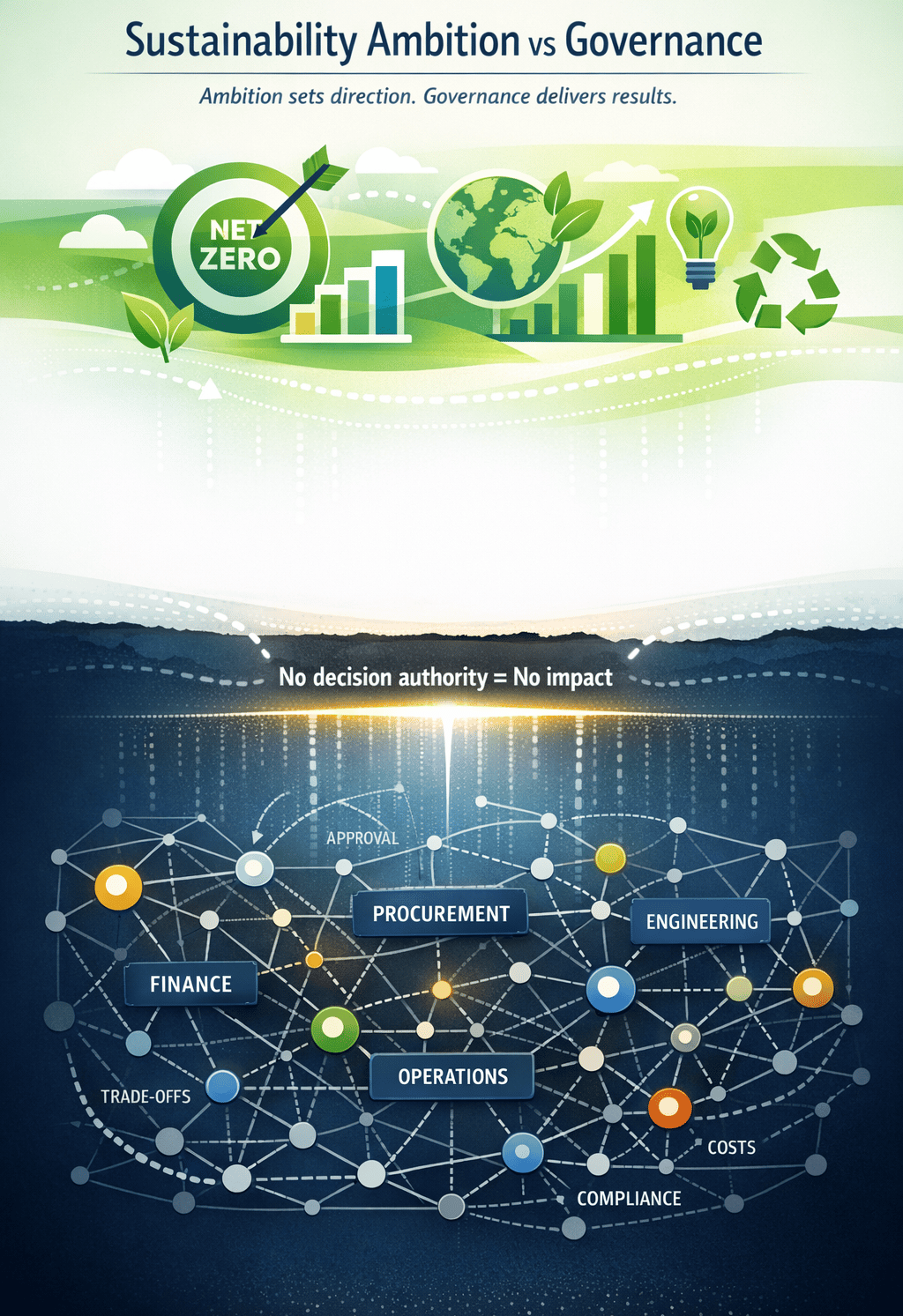
Ambition sets direction. Governance determines outcomes.
The Rise of Sustainability Ambition
Over the past decade, sustainability has moved from a peripheral concern to a strategic priority.
Organizations now routinely commit to:
decarbonization targets
circular economy initiatives
sustainable sourcing strategies
environmental and social performance goals
These commitments are important. They signal intent, align stakeholders, and respond to regulatory and market pressure.
But ambition alone does not change systems.
It does not resolve trade-offs.
It does not allocate resources.
It does not make decisions.
And this is where many sustainability strategies begin to break down.
The Governance Gap
Inside organizations, sustainability often operates in a paradox.
It is treated as strategically important—but structurally weak.
Sustainability teams are expected to:
influence design decisions
shape procurement choices
guide investment priorities
anticipate regulatory risks
Yet in many cases, they lack:
decision authority
budget control
clear accountability structures
This creates a fundamental misalignment.
Sustainability is responsible for outcomes it does not control.
When this happens, even the most ambitious strategies become difficult—if not impossible—to execute.
Why Governance Matters
Governance defines how decisions are made, who makes them, and how trade-offs are resolved.
In sustainability, this is critical.
Because sustainability is not a standalone objective. It intersects with:
cost
performance
risk
speed
regulatory compliance
Every meaningful sustainability decision involves trade-offs.
For example:
Should a more sustainable material be chosen if it increases cost?
Should product redesign be prioritized over time-to-market?
Should long-term environmental risk outweigh short-term financial targets?
Without governance, these questions are resolved inconsistently—or avoided entirely.
Governance ensures that sustainability is not just considered, but decisive.
Decision Rights: Who Actually Decides?
One of the most overlooked aspects of sustainability is decision rights.
Organizations often define sustainability goals but fail to define:
who has the authority to act on them
who resolves conflicts between sustainability and other objectives
when sustainability overrides short-term optimization
In practice, decisions default to existing structures:
procurement optimizes cost
engineering optimizes performance
operations optimize efficiency
Sustainability becomes a secondary consideration—not because it lacks importance, but because it lacks authority.
To be effective, sustainability must be embedded into decision-making structures, not just strategic documents.
Accountability: From Targets to Ownership
Targets without accountability rarely drive change.
Many organizations track sustainability performance through KPIs and dashboards. But measurement alone does not ensure action.
The critical question is:
Who is accountable when sustainability targets are not met?
Without clear ownership:
targets remain aspirational
trade-offs remain unresolved
progress remains inconsistent
Effective governance assigns responsibility at the level where decisions are made.
This means linking sustainability outcomes to:
product development teams
procurement functions
investment committees
operational leadership
When accountability is clear, sustainability becomes part of how performance is evaluated—not just how it is reported.
Cross-Functional Authority: Breaking Silos
Sustainability challenges rarely fit within a single function.
They require coordination across:
engineering
procurement
operations
compliance
finance
However, most organizations are structured in silos.
Each function has its own objectives, incentives, and performance metrics.
Without cross-functional governance, sustainability becomes fragmented:
innovation moves too fast
compliance intervenes too late
procurement prioritizes cost
sustainability tries to reconcile everything
The result is friction—and often inaction.
Effective governance creates mechanisms to align these functions, such as:
shared decision frameworks
integrated stage-gate processes
escalation paths for unresolved trade-offs
This is how sustainability moves from coordination to integration.
From Ambition to Execution
Organizations that succeed in sustainability do not necessarily have more ambitious targets.
They have better governance.
They:
embed sustainability criteria into decision processes
align incentives across functions
define clear decision rights
assign accountability where decisions occur
integrate sustainability into investment and design logic
In these organizations, sustainability is not an external objective.
It is part of the operating system.
Europe and Latin America: Different Contexts, Same Challenge
The governance gap appears across regions, though in different forms.
In Europe, sustainability is often driven by strong regulatory frameworks. The challenge is managing complexity and ensuring that governance systems translate compliance into action.
In Latin America, sustainability efforts may face structural constraints, including limited resources and institutional capacity. Governance becomes critical to prioritize actions and allocate resources effectively.
Different contexts.
Same underlying issue:
Ambition without governance does not deliver results.
A Final Thought
Sustainability ambition is necessary.
But it is not sufficient.
Real progress depends on the systems that turn ambition into decisions—and decisions into outcomes.
Because in the end:
Ambitious sustainability targets without governance are organizational fiction.
At Abaeco Consultants, we work with organizations to move beyond ambition—designing governance systems that make sustainability actionable, measurable, and scalable.
Because sustainability only works when it is built into how decisions are made.