
Why Sustainability Dies in Meetings—Not in Strategy
Sustainability doesn’t collapse in vision statements. It disappears in everyday decisions—one meeting at a time.
5/20/20261 min read
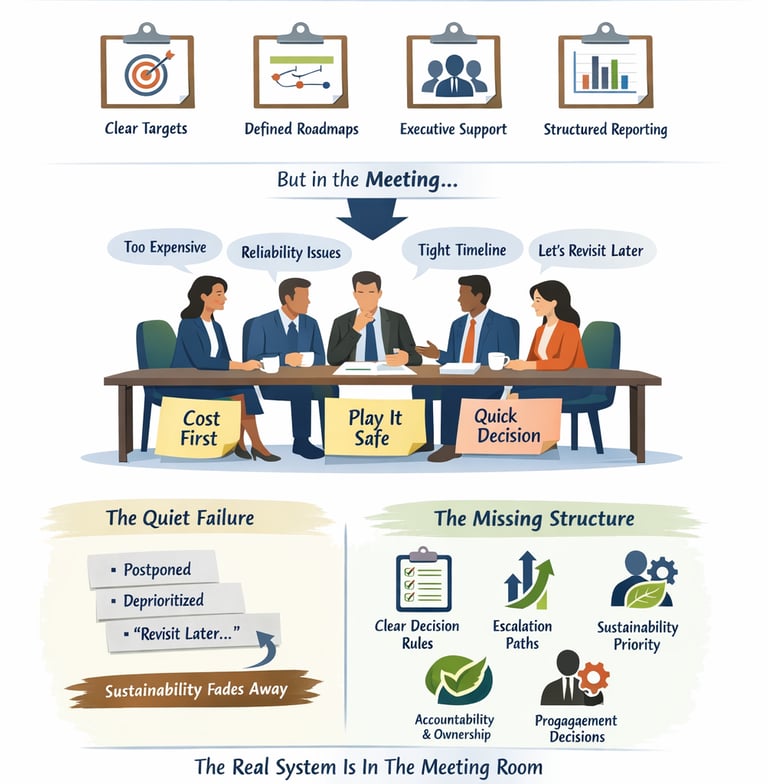
The Strategy Looks Perfect
Most organizations do not lack sustainability ambition.
They have:
clear targets
defined roadmaps
executive support
structured reporting
On paper, everything is aligned.
And yet, progress often stalls.
Not dramatically.
But gradually.
Where It Actually Breaks
Sustainability does not fail in strategy documents.
It fails in meetings.
In:
design reviews
procurement discussions
budget conversations
project approvals
These are the moments where decisions are made.
And where sustainability is quietly negotiated away.
The Meeting Dynamic
Consider a typical scenario:
A product team evaluates a new material.
Sustainability prefers a lower-impact option
Procurement flags higher cost
Operations raises concerns about reliability
Project management highlights timeline risk
The discussion becomes a trade-off.
But here’s the issue:
👉 there is no clear rule for resolving it
What Happens Next
Without defined decision logic, the group defaults to:
lowest cost
lowest risk
fastest path
Sustainability is acknowledged.
Discussed.
Even supported in principle.
But not chosen.
The Quiet Failure
No one rejects sustainability explicitly.
Instead, it is:
postponed
deprioritized
“revisited later”
Which rarely happens.
This is how sustainability dies:
Not through opposition—
but through deferral.
Why Meetings Are the Real System
Organizations often think their system is defined by:
strategy
KPIs
governance frameworks
In reality, the system operates through decisions made in meetings.
That is where:
priorities compete
trade-offs are resolved
outcomes are determined
If sustainability is not structurally embedded in those moments, it will not survive them.
The Missing Element: Decision Structure
Most meetings lack:
clear decision ownership
defined escalation paths
rules for resolving trade-offs
authority to prioritize sustainability
So decisions default to what feels safe.
The Cost of Informal Decisions
When sustainability is handled informally:
decisions become inconsistent
accountability becomes unclear
progress depends on individuals—not systems
This creates:
internal frustration
stalled initiatives
loss of momentum
What Needs to Change
Organizations that succeed treat meetings as part of their operating system.
They:
define who decides—and under what conditions
embed sustainability into decision criteria
clarify when it overrides other priorities
align incentives across functions
Meetings become structured decision points—not negotiation arenas.
A Final Thought
Sustainability does not fail because of poor strategy.
It fails because, in the moment of decision, no one is required—or empowered—to choose it.