
Why Most Circular Opportunities Are Economically Misunderstood
Most companies misjudge circular opportunities because they use linear economic logic. This article explains why — and how to uncover the real value hidden in circular systems.
6/5/20262 min read
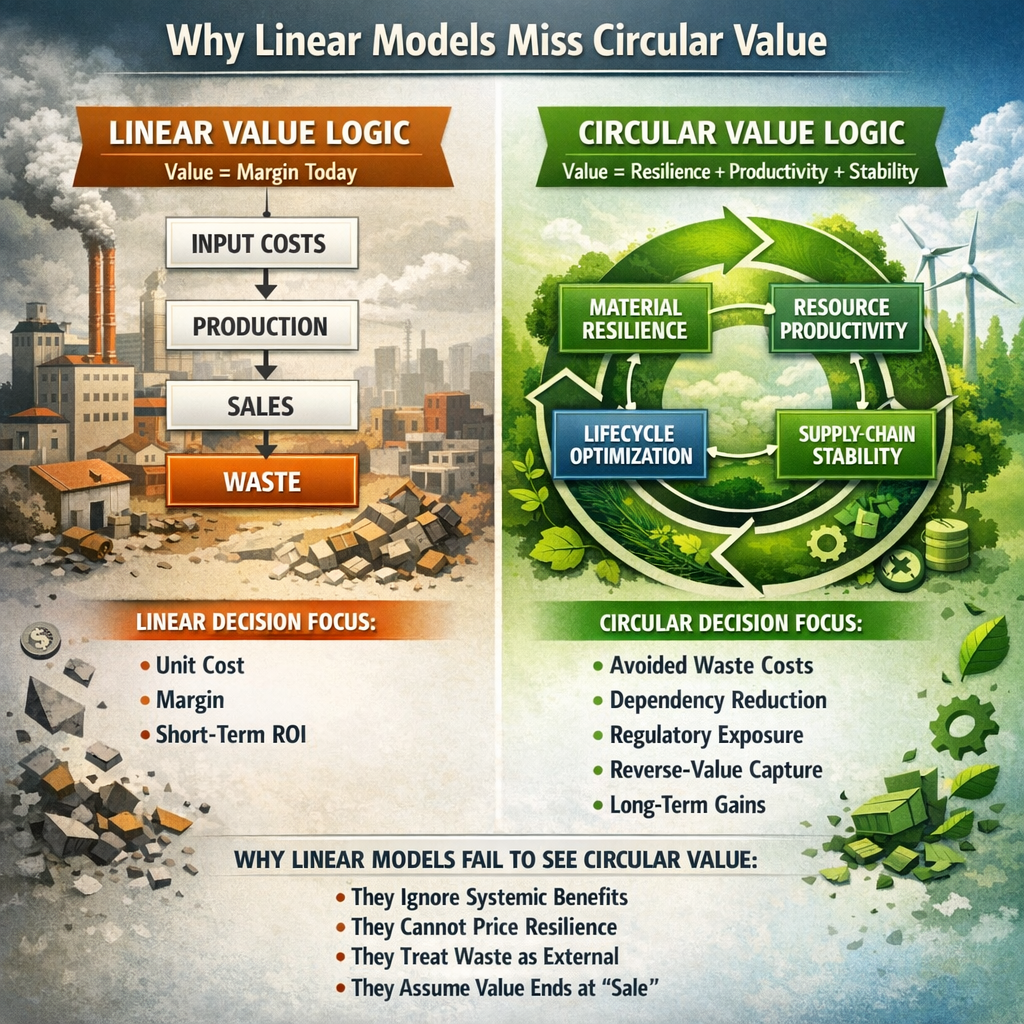
Most companies evaluate circularity with linear logic — and that’s exactly why they miss its real economic value.
The Real Reason Circular Opportunities Are Misjudged
Across industries, circularity is still treated as a sustainability experiment — a “nice-to-have” pilot, a compliance buffer, or a branding exercise. But the real issue is deeper:
→ Most organizations evaluate circular opportunities using linear economic logic.
And linear logic cannot see circular value.
It’s like trying to evaluate a network using the rules of a pipeline — the math simply doesn’t work.
Circularity Creates Value in Ways Traditional Finance Models Cannot See
Circular systems generate value through:
Risk reduction (supply volatility, price shocks, regulatory exposure)
Material resilience (less dependency on virgin inputs)
Resource productivity (more value per unit of material)
Lifecycle optimization (design choices that reduce future costs)
Supply-chain stability (less exposure to disruptions)
But here’s the problem:
→ None of these value streams appear in a standard ROI spreadsheet.
Traditional financial models were built for linear flows:
buy → make → sell → discard
Circularity breaks that logic.
The Hidden Costs Linear Models Ignore
When companies evaluate circular opportunities, they often miss:
Avoided waste costs
Future regulatory exposure
Material dependency risk
Reverse-value capture (service models, refurbishment, secondary markets)
End-of-life liabilities
Volatility buffering (hedging through circular flows)
These are not “soft benefits.” They are real economic levers — just invisible to linear accounting.
Why Circular Opportunities Die Too Early
Most circular initiatives fail not because they lack potential, but because:
1. Finance models are incomplete
They capture direct costs, but not systemic value.
2. Value is distributed across departments
Procurement saves money. Operations reduces waste. Design improves durability. But no single owner captures the full benefit.
3. Long-term operational gains are invisible
Circularity often pays back through resilience, not immediate margin.
4. Decision rights are misaligned
The people who could unlock circular value often don’t have authority.
The result?
→ Companies reject circular opportunities for the wrong reasons.
The Strategic Blind Spot: Linear Decision Systems
Most organizations have:
sustainability strategies
ESG reporting
innovation frameworks
circularity ambitions
But when real decisions are made — design, sourcing, investment — circularity rarely wins.
Not because it lacks value. But because the decision system is not designed to recognize circular value.
This is the core insight:
→ Circularity fails in the decision system, not in the business case.
Abaeco’s Positioning: We Reveal the Real Economics of Circularity
At Abaeco Consultants, we help organizations uncover the true economic potential hidden inside circular systems.
Not through generic circularity assessments. Not through sustainability checklists. But through decision-system analysis:
where value is created
where it is lost
who owns it
who blocks it
and how to redesign decisions to capture it
This is where circularity becomes economically meaningful.