Who Actually Decides Sustainability in Your Organization?
Responsibility is everywhere. Authority is nowhere. And that’s where sustainability breaks.
5/5/20261 min read
Most organizations believe sustainability is embedded across the business.
It appears:
in strategy
in KPIs
in reporting systems
in corporate communication
Everyone is involved.
Which creates a critical illusion:
that sustainability is owned.
In reality, it often isn’t.
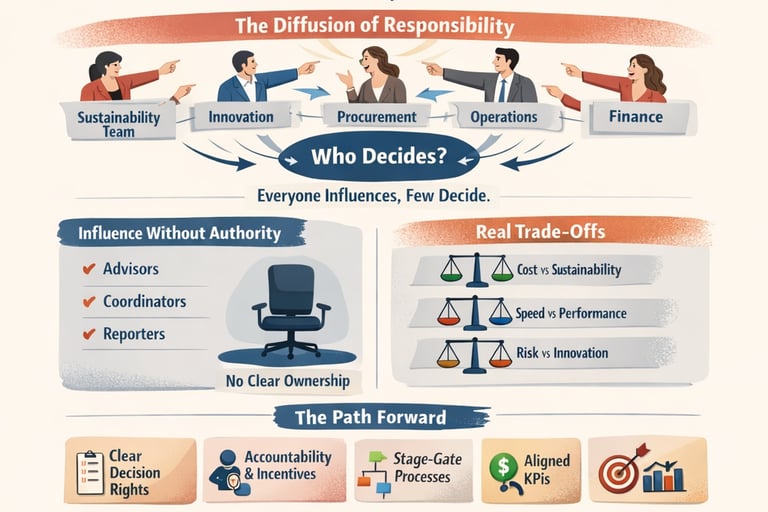
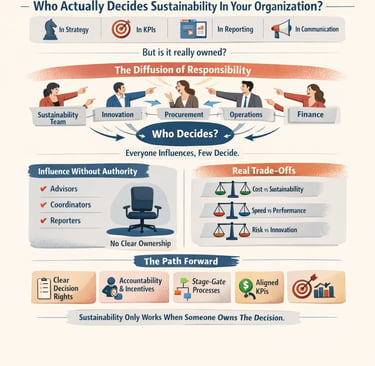
The Diffusion of Responsibility
Ask a simple question inside most organizations:
Who decides sustainability?
The answers are usually unclear:
Sustainability teams define targets
Innovation teams design products
Procurement manages suppliers
Operations control execution
Finance controls budgets
Each function influences sustainability.
But very few can decide it.
Influence Without Authority
Sustainability teams are typically positioned as:
advisors
coordinators
reporting owners
They provide:
data
frameworks
recommendations
But they rarely control:
budgets
timelines
design specifications
This creates a structural imbalance:
responsibility without authority.
And in organizations, authority always wins.
Where Sustainability Gets Overruled
When real trade-offs emerge, priorities become clear:
cost vs sustainability
speed vs environmental performance
risk vs innovation
In these moments:
procurement optimizes cost
engineering optimizes performance
operations optimize efficiency
Sustainability becomes:
a consideration
a discussion point
a justification
But rarely the deciding factor.
The Decision Vacuum
The real problem is not resistance.
It is absence of ownership.
No one is clearly responsible for:
resolving trade-offs
prioritizing sustainability under constraint
making final decisions when objectives conflict
This creates a decision vacuum.
And in a vacuum, default incentives take over.
Why Governance Matters More Than Awareness
Most organizations invest heavily in:
training
ESG reporting
sustainability communication
These increase awareness.
But awareness does not change decisions.
Governance does.
Without:
defined decision rights
clear accountability
aligned incentives
Sustainability remains optional.
The Hidden Organizational Truth
Sustainability is not integrated
until it has authority over decisions.
This requires:
embedding sustainability into stage-gate processes
linking KPIs to decision ownership
defining escalation paths for conflicts
aligning incentives across functions
In other words: designing who decides.
The Cost of Not Deciding
When ownership is unclear, organizations experience:
stalled initiatives
inconsistent decisions
internal friction
delayed progress
Sustainability doesn’t fail dramatically.
It erodes quietly.
A Simple Test
To understand your organization’s maturity, ask:
Who can stop a project on sustainability grounds?
Who decides when sustainability conflicts with cost?
Who owns Scope 3 trade-offs?
If the answers are unclear— you don’t have a sustainability strategy.
You have a coordination problem.
A Final Thought
Sustainability does not fail because people don’t care.
It fails because no one is empowered to decide.
Responsibility is distributed.
Authority is not.
At Abaeco Consultants, we help organizations define who decides—
and design governance systems where sustainability is not optional.
Because sustainability only works
when someone owns the decision.