
When KPIs Conflict, Sustainability Always Loses
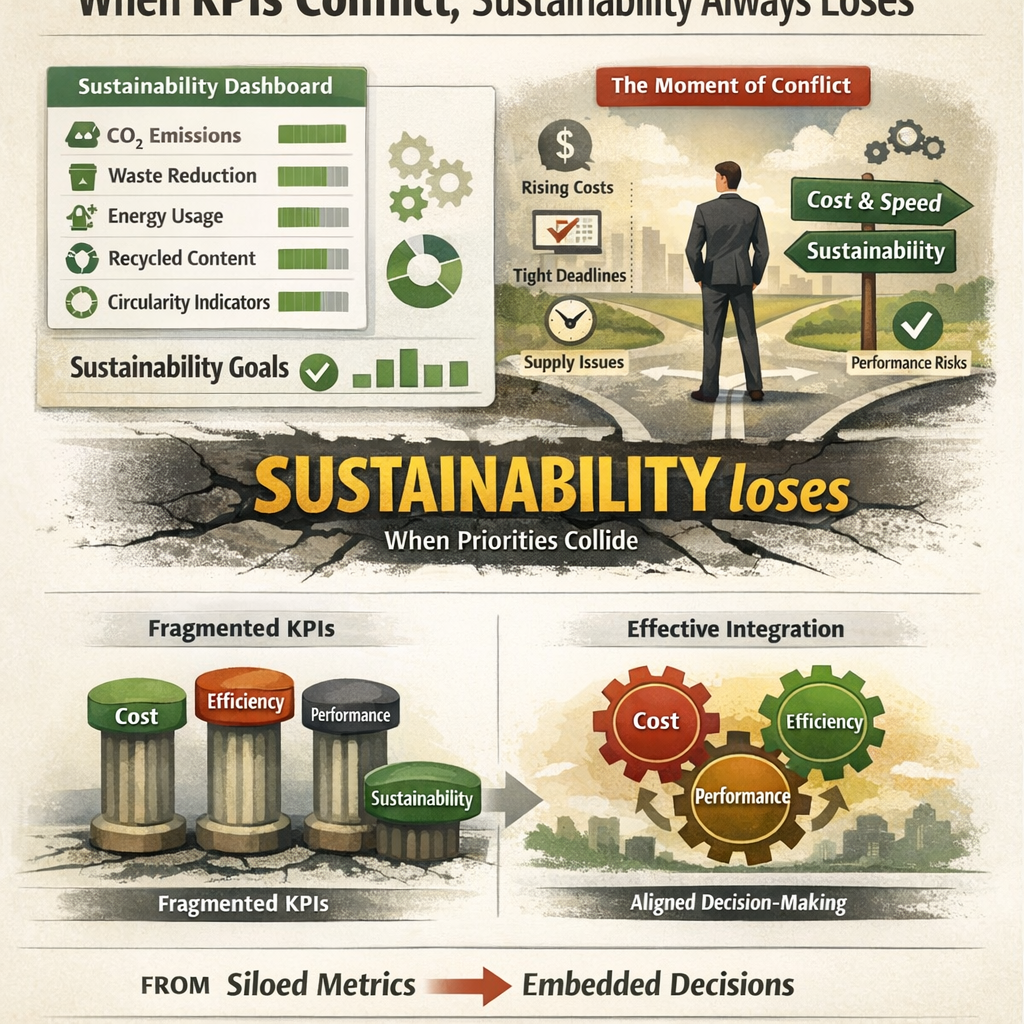
Sustainability doesn’t fail because it isn’t measured. It fails because it isn’t decisive when trade-offs matter.
5/13/20261 min read
The Illusion of Alignment
Most organizations believe they have integrated sustainability into their performance systems.
They track:
emissions
waste
energy use
recycled content
circularity indicators
Dashboards look complete.
Targets are defined.
Progress is reported.
And yet—when real decisions are made—sustainability often disappears.
Not visibly.
But decisively.
The Moment That Matters
Sustainability is not tested in reporting cycles.
It is tested in moments of conflict.
When:
cost increases
timelines tighten
performance risks emerge
supply constraints appear
That is when priorities are revealed.
And in those moments, one pattern appears consistently:
👉 sustainability loses.
Why It Happens
The issue is not a lack of commitment.
It is structural.
Most organizations operate with multiple KPI systems that are not aligned:
Procurement is measured on cost
Operations on efficiency and stability
R&D on performance and speed
Sustainability on environmental indicators
Each function optimizes its own metrics.
No one owns the trade-offs.
KPIs Without Authority
Sustainability KPIs often exist in parallel—not in control.
They:
inform
monitor
report
But they rarely:
override
redirect
decide
So when conflicts arise, decision-makers revert to what is:
immediate
measurable
incentivized
Which is rarely sustainability.
The Hidden Dynamic
This creates a quiet but powerful dynamic:
Sustainability is present in the system—
but absent in the decision.
Not because it is ignored.
But because it is not structurally empowered.
When Measurement Becomes Symbolic
In this context, KPIs become symbolic.
They:
demonstrate intent
support reporting
create visibility
But they do not shape outcomes.
This is why organizations can:
meet sustainability targets
publish strong reports
and still make decisions that undermine long-term impact
The Real Problem Is Not Metrics—It’s Governance
The issue is not the number of KPIs.
It is how they connect to decisions.
Key questions often remain unanswered:
Who decides when sustainability conflicts with cost?
Which KPI takes precedence?
What escalation mechanism exists?
Who is accountable for trade-offs?
Without clear answers, sustainability remains secondary.
What Leading Organizations Do Differently
Organizations that succeed don’t just measure sustainability.
They embed it into decision logic.
They:
align KPIs with decision rights
define trade-off rules explicitly
integrate sustainability into stage-gate processes
ensure accountability across functions
Sustainability becomes part of how decisions are made—not an input that competes with them.
A Final Thought
Sustainability does not fail because it is not measured.
It fails because, when KPIs conflict,
it is not designed to win.