
The Missing Business Case in Circular Economy Initiatives
Circularity creates value only when environmental ambition is translated into operational, financial, and strategic outcomes. Without a credible business case, even the most promising circular initiatives struggle to move beyond pilot projects.
6/23/20263 min read
The Missing Business Case in Circular Economy Initiatives
Few business concepts have gained as much attention in recent years as the circular economy. Organizations across sectors have embraced circularity commitments, launched recycling initiatives, explored product take-back schemes, and announced ambitious resource-efficiency targets.
Yet despite growing enthusiasm, many circular economy initiatives fail to progress beyond small-scale demonstrations.
The reason is often surprisingly simple:
The business case was never properly developed.
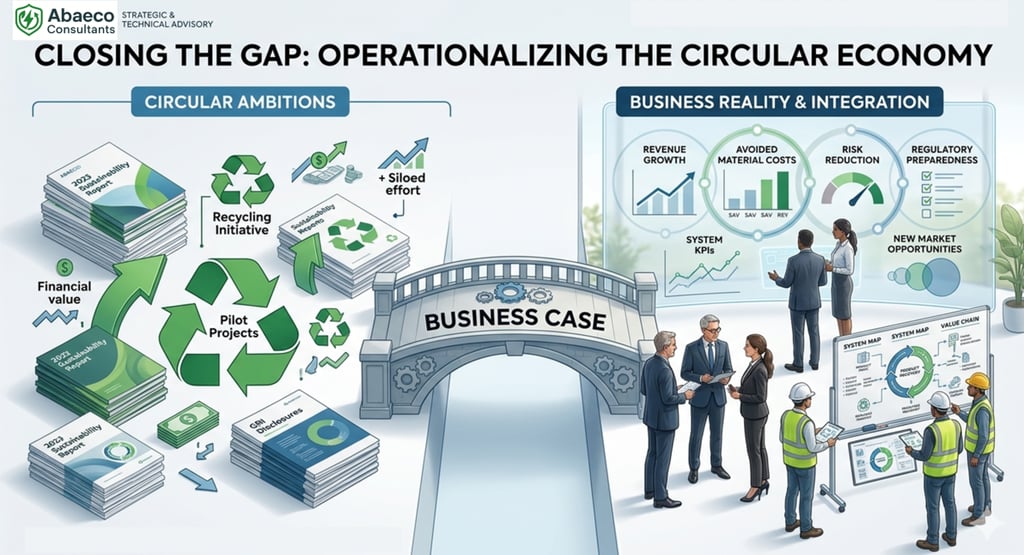
Circularity is frequently treated as an environmental objective rather than a business transformation strategy. Companies invest time and resources into pilots because they appear innovative, align with sustainability commitments, or respond to stakeholder expectations. However, when initiatives are later evaluated through traditional financial criteria, many cannot demonstrate sufficient value creation.
The result is predictable.
Projects stall.
Budgets disappear.
Teams lose momentum.
And organizations conclude that circularity is too expensive, too complex, or not commercially viable.
The issue is rarely circularity itself.
The issue is that the economic logic was never designed alongside the circular strategy.
Circularity Does Not Automatically Generate Value
A common misconception is that circular business models inherently reduce costs and increase profitability.
In practice, circular systems often require additional investments:
Reverse logistics infrastructure;
Product redesign;
New supplier relationships;
Tracking and traceability systems;
Sorting, refurbishment, or remanufacturing capabilities;
Digital platforms to manage material flows.
These investments can be substantial.
At the same time, the benefits are not always immediate or easily measured.
Potential gains may include:
Reduced exposure to volatile raw material prices;
Increased resource productivity;
New revenue streams from secondary materials;
Improved customer retention through service-based models;
Reduced regulatory risk;
Greater resilience against supply disruptions.
Many of these benefits emerge over longer time horizons and cut across multiple business functions.
Unfortunately, organizations often evaluate circular projects using short-term metrics designed for conventional linear investments.
As a consequence, initiatives with strong strategic potential may appear financially unattractive.
Why Circular Pilots Often Struggle
Several recurring challenges can be observed.
1. Environmental Benefits Are Assumed to Equal Financial Benefits
Reducing waste is important.
Reducing emissions is essential.
But neither automatically improves profitability.
Decision-makers still need answers to questions such as:
What costs are avoided?
What revenues are generated?
How quickly are investments recovered?
How sensitive is the model to market fluctuations?
How does circularity affect competitiveness?
Without these answers, sustainability teams frequently struggle to secure long-term internal support.
2. Value Creation Is Distributed Across Departments
Circular initiatives rarely fit neatly within existing organizational structures.
Savings may occur in procurement.
Revenue opportunities may appear in commercial teams.
Risk reductions may benefit compliance departments.
Operational efficiencies may be realized in manufacturing.
However, investment decisions are often evaluated within isolated departmental budgets.
No single business unit captures the full value.
As a result, promising initiatives may never receive approval.
3. Risk Reduction Is Rarely Monetized
Circularity can strengthen resilience by:
Diversifying material sources;
Reducing dependency on virgin resources;
Improving supply chain stability;
Anticipating future regulations;
Enhancing resource security.
These advantages have economic significance.
Yet organizations seldom quantify them.
Instead, projects are judged primarily on immediate cost savings.
This overlooks one of circularity's greatest strategic contributions:
Reducing future business uncertainty.
Building a Strong Circular Business Case
Successful organizations tend to approach circularity differently.
They evaluate initiatives through multiple lenses.
Economic Performance
Assess:
Capital expenditure;
Operating costs;
Revenue potential;
Payback periods;
Net present value.
Operational Feasibility
Understand:
Material availability;
Reverse logistics requirements;
Processing capacity;
Product durability;
Infrastructure readiness.
Strategic Value
Consider:
Regulatory preparedness;
Brand positioning;
Customer expectations;
Supply chain resilience;
Access to emerging markets.
Environmental Performance
Measure:
Carbon footprint reductions;
Resource productivity;
Waste minimization;
Circularity indicators;
Biodiversity impacts where relevant.
When these dimensions are assessed together, circularity becomes easier to justify internally.
It moves from being viewed as a sustainability cost to being recognized as a strategic investment.
Circularity Is Ultimately a System Design Challenge
Circular economy initiatives succeed when organizations move beyond asking:
"Can we recycle this?"
And begin asking:
"How do we redesign the system so value can circulate over time?"
This requires integrating engineering realities, business objectives, logistics capabilities, and sustainability outcomes from the beginning.
Companies that treat circularity as a redesign exercise are more likely to discover opportunities that competitors overlook.
They identify value not only in materials, but also in information flows, service models, partnerships, and operational efficiencies.
The Opportunity Ahead
As resource constraints intensify, regulations evolve, and customers demand greater transparency, organizations that understand the economics of circularity will gain a significant advantage.
The challenge is not identifying circular ideas.
There are already plenty.
The challenge is determining which opportunities create measurable business value, which require enabling conditions to succeed, and which may remain technically interesting but commercially unviable.
Circularity does not need more pilots.
It needs better investment decisions.
Organizations that can bridge sustainability ambition with operational and economic reality will be best positioned to scale circular solutions and capture long-term competitive benefits.
How This Connects to ABAECO
At ABAECO, we believe circularity should be assessed not only through environmental aspirations, but through technical feasibility, operational readiness, and business performance.
Our Circular System Opportunity Scan helps organizations identify where circular strategies can realistically create value, evaluate implementation barriers, and prioritize opportunities with the greatest potential for economic, environmental, and strategic impact.
Because circular economy initiatives should not simply look sustainable.
They should work, scale, and deliver measurable results.