
The Hidden Gap Between ESG Data and Executive Decisions
Organizations are drowning in ESG data—yet starving for decisions. The problem is not information. It’s where—and when—it matters.
4/17/20262 min read
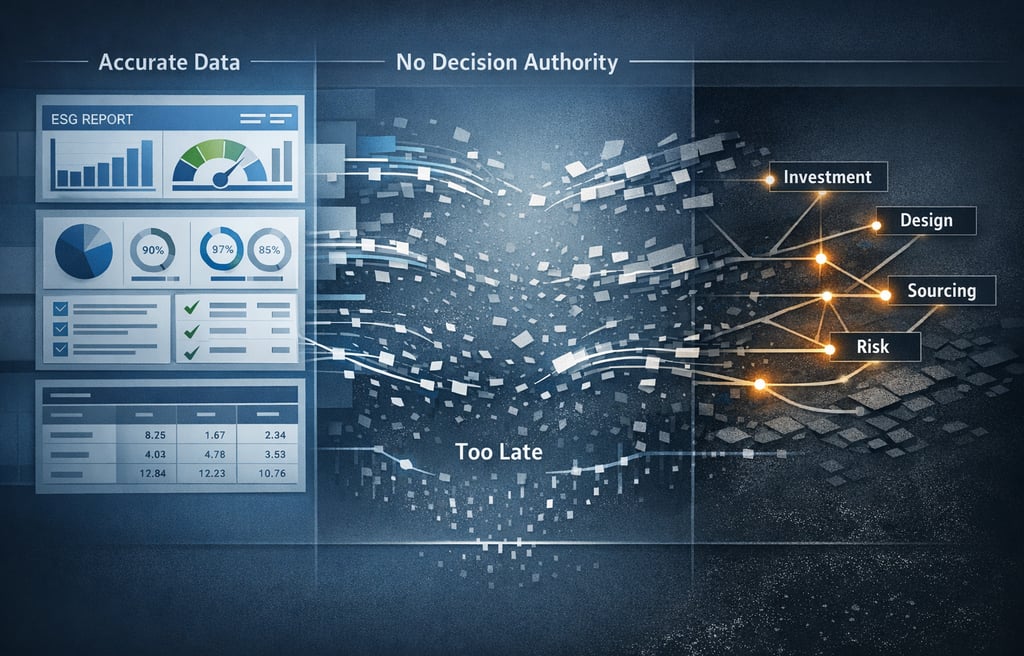

ESG data has never been more abundant.
Dashboards are sophisticated.
Reporting cycles are tighter.
Assurance processes are improving.
On paper, organizations appear more informed than ever.
Yet when real decisions arise—about design, sourcing, investment, or market entry— ESG data is often set aside.
Not because it is wrong.
But because it is not present where decisions are made.
ESG Data Is Built for Reporting—Not for Decisions
Most ESG systems are designed to answer retrospective questions:
What were our emissions last year?
Are we aligned with targets?
Are we compliant with reporting requirements?
These are important.
But they are not the questions decision-makers face.
Real decisions require answers to:
Which option should we choose today?
What trade-off is acceptable under uncertainty?
When should sustainability override cost or speed?
ESG systems rarely answer these.
So decision-makers proceed without them.
The Timing Problem No One Talks About
A structural disconnect exists inside most organizations:
ESG data is produced centrally
Decisions are made locally
Timing does not align
By the time ESG insights reach:
design reviews
procurement decisions
investment committees
…the critical choices are already locked in.
At that point, data becomes explanatory—
not actionable.
When Data Has No Authority, It Has No Impact
Even when ESG data is available, another issue emerges:
it lacks decision authority.
Organizations measure:
Scope 3 emissions
environmental impacts
circularity metrics
But they rarely define:
who owns the trade-offs
who decides when ESG conflicts with cost
who has authority to act on the data
This creates a familiar outcome:
Data is acknowledged.
Then ignored.
The Illusion of Control
Paradoxically, more ESG data often increases uncertainty.
More metrics create:
competing signals
fragmented priorities
analysis paralysis
Executives feel informed—but not confident.
This is why organizations with the most advanced reporting systems often struggle the most to act.
They have visibility.
But not direction.
The Real Gap: Data Without Decision Architecture
The issue is not ESG maturity.
It is decision architecture.
Organizations that successfully use ESG data do something fundamentally different:
they link data to decision gates
they define escalation paths for conflicts
they assign authority for trade-offs
they integrate sustainability into investment logic
In these systems, ESG data is not an output.
It is an input to decisions.
From Reporting to Decision Systems
Closing the gap requires a shift:
From:
reporting performance
To:
structuring decisions
This means:
embedding ESG criteria into design and procurement
aligning metrics with accountability
ensuring data arrives before—not after—decisions
connecting sustainability to capital allocation
Only then does ESG data become relevant.
A Final Thought
The problem with ESG data is not accuracy.
It is irrelevance at the moment of decision.
Organizations do not fail because they lack information.
They fail because information is disconnected from authority.
The hidden gap is not in the data.
It is in the decisions.
At Abaeco Consultants, we help organizations close this gap—
by redesigning how ESG data flows into real decisions.
Because sustainability does not improve when data is better.
It improves when decisions are.