
The Circular Economy: Beyond Vision — From Concept to System Design
Circularity is not about recycling more. It’s about redesigning how value is created, preserved, and recovered.
4/10/20262 min read
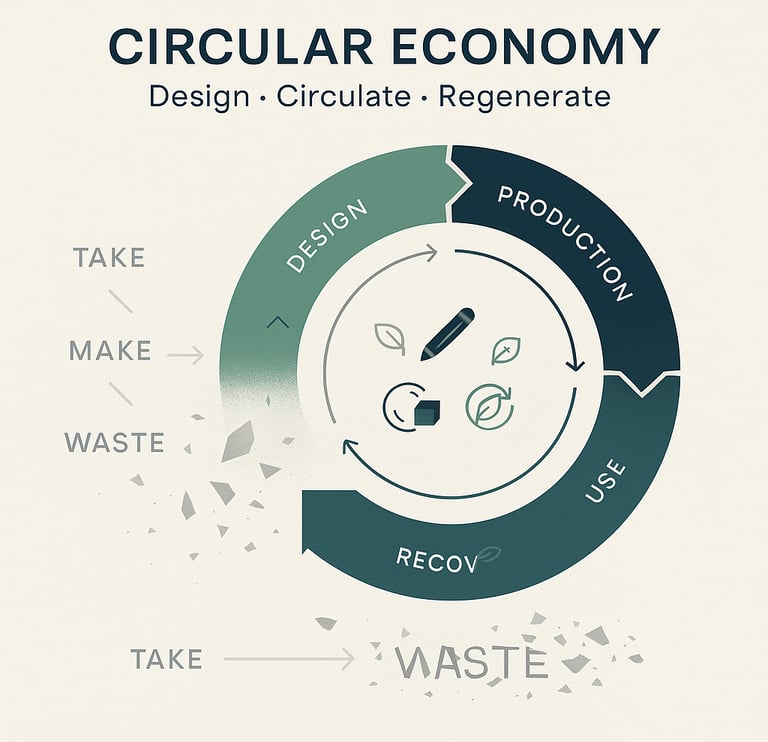
From Concept to System Reality
The circular economy has become one of the most influential concepts in sustainability. Much of its global momentum can be traced to the work of the Ellen MacArthur Foundation, which has reframed how businesses, policymakers, and industries think about resources, waste, and value creation.
At its core, the circular economy challenges a fundamental assumption:
That economic growth must rely on resource consumption.
Instead, it proposes a system where value is maintained—not destroyed—over time.
But while the concept is widely accepted, execution remains uneven.
Because circularity is not a vision problem.
It is a design and governance challenge.
The Limits of the Linear System
Most industries still operate under a linear model:
extract → produce → consume → discard
This model has delivered scale and efficiency—but at the cost of:
resource depletion
environmental degradation
systemic waste
The issue is not only environmental.
It is structural.
Linear systems are optimized for throughput, not value preservation.
What the Circular Economy Really Requires
The circular economy is often described through three principles:
eliminate waste and pollution
circulate products and materials
regenerate natural systems
These are directionally correct.
But they remain aspirational unless translated into operational decisions.
Circularity is not achieved through intention.
It is achieved through engineering, design, and system coordination.
Design Determines Circular Outcomes
One of the most overlooked realities is this:
Circularity is decided long before a product reaches the market.
Key design decisions determine whether materials can ever be recovered:
material selection and compatibility
product architecture and modularity
disassembly feasibility
durability and repairability
When these decisions ignore circularity, downstream systems—recycling, recovery, reuse—inherit constraints they cannot overcome.
This is why many circular initiatives default to recycling.
Not because it is optimal.
But because everything else has already been designed out.
Circulation Is a System, Not an Action
Keeping materials in use requires more than good intentions.
It requires systems such as:
reverse logistics
sorting and quality control
remanufacturing infrastructure
market mechanisms for secondary materials
These systems introduce complexity:
variable material quality
uncertain flows
economic trade-offs
Circular systems are not simply linear systems running backwards.
They are structurally different systems that must be designed as such.
Regenerating Nature Requires More Than Substitution
The third principle—regenerating natural systems—is often misunderstood.
Switching to bio-based or renewable materials is not enough.
Without circular design:
land use pressures increase
resource demand shifts upstream
environmental burdens are relocated, not reduced
This is where circularity intersects with bioeconomy design and Safe and Sustainable by Design (SSbD).
The objective is not substitution.
It is system optimization.
What Leading Organizations Do Differently
Organizations that succeed with circular economy move beyond pilots and narratives.
They:
embed circular criteria into product design
assign ownership for material loops
align incentives across functions
design supply chains for reverse flows
integrate life cycle thinking into decisions
Most importantly:
They treat circularity as operating infrastructure—not as a sustainability initiative.
From Vision to Execution
The Ellen MacArthur Foundation has played a critical role in defining the vision of a circular economy.
The next challenge is execution.
And execution depends on:
engineering decisions
governance structures
economic viability
system integration
Circularity does not fail because the idea is wrong.
It fails because systems are not designed to support it.
A Final Thought
The circular economy is not about doing less harm.
It is about designing systems that do not create waste in the first place.
The organizations that lead will not be those that adopt circular language—
but those that translate circular principles into real, operational decisions.
At Abaeco Consultants, this is where we focus:
Helping organizations move from circular ambition to circular systems that work—technically, economically, and at scale.
Because circularity only delivers value when it is designed to.