The Bioeconomy Will Fail Without Circular Design
Bio-based solutions are often seen as inherently sustainable—but that assumption is misleading. Without circular design, the bioeconomy risks shifting environmental pressures rather than solving them.
3/30/20263 min read
The bioeconomy is gaining momentum.
Across industries, companies are investing in bio-based materials, biorefineries, and renewable feedstocks as alternatives to fossil-based systems. The promise is compelling: reduced emissions, renewable resources, and alignment with climate goals.
But there is a growing misconception at the core of this transition.
Bio-based does not automatically mean sustainable.
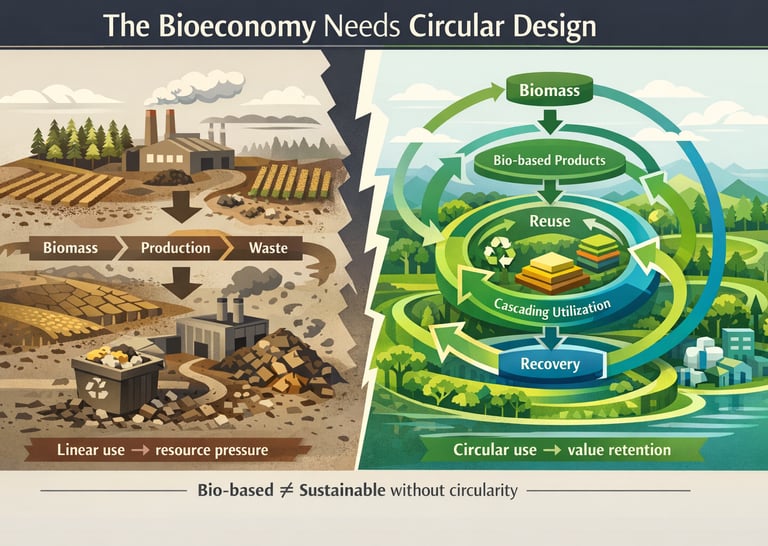
Without circular design, the bioeconomy risks replicating the same structural problems it aims to solve.
The Illusion of “Bio = Sustainable”
Replacing fossil resources with biological ones is often presented as a sustainability solution in itself.
In reality, it is only a partial substitution.
Bio-based systems still depend on:
land
water
energy
fertilizers and chemicals
logistics and processing infrastructure
If these systems are not designed carefully, they can create:
land-use pressure
biodiversity loss
resource inefficiencies
competition with food production
This is why a bio-based product cannot be assumed sustainable by default.
It must be evaluated across its entire life cycle.
Land Use: The Hidden Constraint
One of the most critical challenges in the bioeconomy is land use.
Biological resources require space to grow. That space is finite and already under pressure from:
agriculture
urbanization
ecosystem conservation
climate change
Expanding bio-based production without circular strategies can intensify this pressure.
For example:
producing biomass for single-use applications
converting land for low-efficiency material use
prioritizing volume over value
Without circularity, bio-based systems can shift environmental burdens upstream—into land use and ecosystems.
Resource Efficiency: More Than Renewability
Renewability does not guarantee efficiency.
Biological resources must be used as efficiently as possible to deliver real sustainability benefits.
This means:
maximizing value extracted per unit of biomass
minimizing waste and losses
optimizing energy and water use
In linear systems, even renewable resources can be used inefficiently.
A bio-based material that is produced, used once, and discarded still represents:
lost value
wasted resources
unnecessary environmental impact
Efficiency is not a byproduct of bio-based systems.
It must be designed into them.
Cascading Value Chains: Unlocking Full Potential
One of the most powerful concepts in the bioeconomy is cascading use.
This means using biological resources in multiple stages, extracting maximum value before final disposal.
For example:
using biomass first for high-value materials
then for secondary products
and finally for energy recovery
Cascading systems:
extend resource lifetimes
reduce waste
improve economic viability
lower overall environmental impact
But cascading does not happen automatically.
It requires intentional system design, coordination across industries, and aligned incentives.
Circular Design: The Missing Link
Circular design is what connects the bioeconomy to real sustainability outcomes.
It ensures that products and systems are designed to:
extend material lifetimes
enable reuse and recycling
reduce waste generation
maintain value across multiple life cycles
Without circular design, bio-based products risk becoming:
single-use alternatives
difficult to recover
incompatible with existing recycling systems
This leads to a fundamental problem:
Replacing fossil materials with bio-based ones—without redesigning the system—does not solve sustainability challenges.
It simply shifts them.
Designing Bio-Based Systems for Circularity
To deliver on its promise, the bioeconomy must integrate circular design principles from the start.
This includes:
designing products for recyclability and biodegradability where appropriate
ensuring material compatibility within existing systems
enabling modularity and repair where possible
aligning supply chains for recovery and reuse
It also requires applying life cycle thinking and Safe and Sustainable by Design (SSbD) principles to:
identify environmental hotspots
evaluate trade-offs
guide design decisions early
Circularity must be embedded into product architecture, process design, and system configuration.
Europe and Latin America: Opportunity and Risk
The implications are particularly relevant in regions such as Europe and Latin America.
In Europe, strong regulatory frameworks are accelerating the adoption of bio-based solutions. The challenge is ensuring that these solutions are genuinely sustainable—not just compliant.
In Latin America, the bioeconomy presents significant opportunities due to abundant biological resources. But without circular design, these opportunities risk leading to resource extraction rather than sustainable development.
Different contexts.
Same critical need:
Designing bio-based systems that are both circular and efficient.
A Final Thought
The bioeconomy has the potential to transform how we produce and consume resources.
But only if it avoids the mistakes of the linear economy.
A bio-based product that is not circular:
wastes valuable resources
increases pressure on land and ecosystems
limits long-term sustainability benefits
Because in the end:
A bio-based product that isn’t circular simply shifts the problem upstream.
At Abaeco Consultants, we help organizations design bio-based and circular systems that are technically viable, environmentally sound, and ready for real-world implementation.
Because sustainability is not about what materials we use.
It is about how we design the systems around them.