
The 3 Circular Loops That Actually Create Value (and the Ones That Don’t)
Not all circular loops create value. This article explains which ones do — and why most fail.
6/9/20262 min read
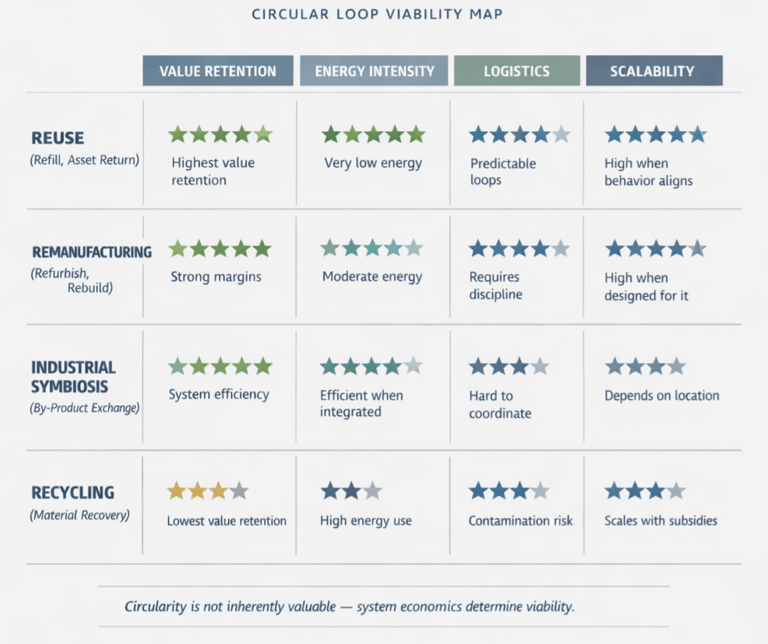
The uncomfortable truth: not all circular loops make sense
Circularity is often presented as a universal solution. But in practice, most circular loops fail — not because the idea is wrong, but because the system economics don’t work.
Some loops generate strong margins and resilience. Others destroy value through logistics, quality degradation, or energy intensity.
Understanding the difference is the key to making circularity economically meaningful.
Loop 1 — Reuse Loops (High Value, Low Complexity)
Examples: refill systems, component reuse, B2B asset rotation, packaging return systems.
Reuse loops tend to be the most economically attractive because:
minimal reprocessing
low energy intensity
high material value retention
predictable reverse logistics
strong customer stickiness
Where they fail: When return rates are low, or when the system requires consumer behavior change that never materializes.
Verdict: Often the strongest margins in circularity.
Loop 2 — Remanufacturing Loops (High Value, High Operational Discipline)
Examples: machinery refurbishment, electronics remanufacturing, industrial equipment rebuilds.
Remanufacturing works when:
products are designed for disassembly
components retain structural integrity
reverse logistics are controlled
quality can be guaranteed
Where they fail:
poor design-for-disassembly
inconsistent core quality
high labor intensity
regulatory barriers
Verdict: ⭐ High-margin when engineered correctly — catastrophic when not.
Loop 3 — Industrial Symbiosis Loops (Systemic Value, Hard to Execute)
Examples: heat cascading, by-product exchange, shared utilities, cross-industry material flows.
These loops create system-level efficiency:
reduced waste
shared infrastructure
lower energy intensity
regional resilience
Where they fail:
dependency on single partners
geographic constraints
coordination failures
regulatory friction
Verdict: Powerful but fragile — requires governance, not just technology.
The Loop That Rarely Works: Recycling (Especially Downcycling)
Recycling is the most celebrated circular loop — and the most misunderstood.
Why recycling often destroys value:
high energy intensity
quality degradation
contamination
volatile secondary markets
logistics costs that exceed material value
In many industries, recycling is economically irrational unless subsidized or mandated.
Verdict: ⚠️ Necessary for compliance — rarely a profit engine.
The Strategic Insight Most Organizations Miss
👉 Circularity is not inherently valuable. System economics determine viability.
A loop only works when:
material value is preserved
logistics are predictable
quality can be guaranteed
energy intensity is low
incentives are aligned
decision rights are clear
This is why so many circular pilots fail: they are chosen for narrative appeal, not economic logic.
Abaeco’s Positioning: We Identify the Loops That Actually Work
At Abaeco Consultants, we help organizations cut through the noise and focus on circular loops that are:
technically feasible
economically scalable
operationally stable
strategically aligned
Not “circularity for the sake of circularity.” But circularity that creates real business value.