SSbD vs Compliance: Why Most Companies Misunderstand the Difference
Compliance asks whether a product can be placed on the market today. SSbD asks whether it should be designed differently to remain viable tomorrow.
7/1/20263 min read
For many organizations, sustainability has become synonymous with compliance.
Companies conduct regulatory assessments, complete environmental declarations, monitor restricted substances, and ensure products meet applicable standards. Once the boxes are ticked, the assumption is often that sustainability has been adequately addressed.
But compliance and Safe-and-Sustainable-by-Design (SSbD) are not the same thing.
Confusing the two may be one of the biggest strategic mistakes companies make when developing new products, technologies, and industrial processes.
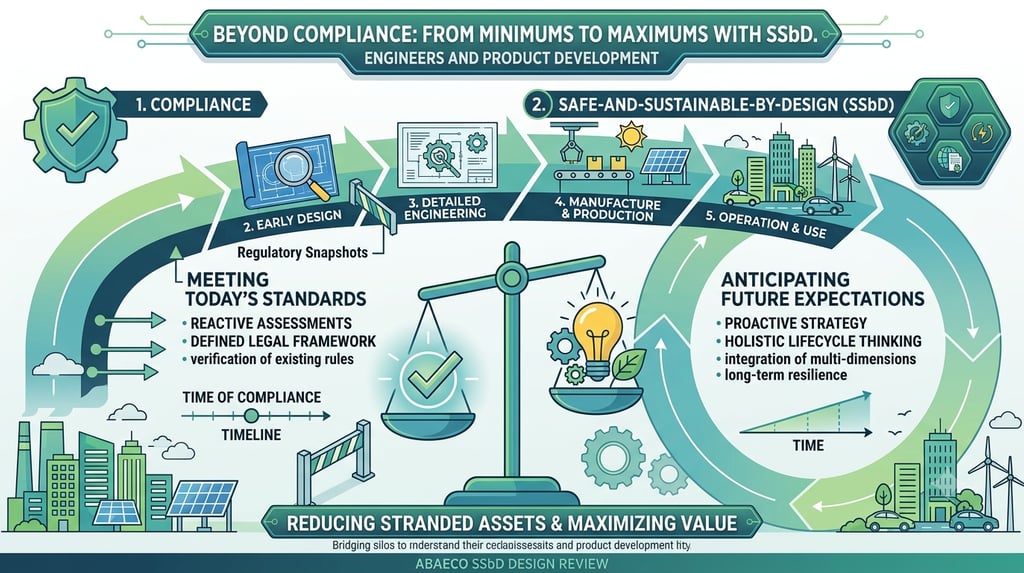
Compliance is about meeting existing requirements.
SSbD is about anticipating future expectations, reducing risks before they emerge, and making better design decisions from the beginning.
The distinction matters because products designed only to satisfy today's regulations can quickly become tomorrow's stranded assets.
Compliance is a Snapshot in Time
Regulatory compliance operates within a defined legal framework.
It focuses on demonstrating that a product, process, or material satisfies current requirements related to safety, environmental protection, and market access.
Examples include:
Chemical registrations and restrictions;
Environmental permitting;
Product certifications;
Carbon disclosure obligations;
Waste and recycling requirements;
Occupational health and safety standards.
These obligations are essential.
No company can operate without meeting them.
However, compliance has an inherent limitation:
It is reactive.
It responds to rules that already exist.
By the time legislation enters into force, design choices have often been locked in years earlier.
Companies may then face expensive redesigns, supply chain disruptions, or accelerated product obsolescence.
Compliance tells organizations what regulators require today.
It rarely provides guidance on how products should evolve to remain competitive under changing regulatory conditions.
SSbD Changes the Question
Safe-and-Sustainable-by-Design shifts the discussion upstream.
Instead of asking:
"Are we compliant?"
SSbD asks:
"Are we making design decisions that minimize future risks and maximize long-term sustainability performance?"
The objective is not merely avoiding non-compliance.
It is designing systems that remain technically robust, environmentally responsible, economically viable, and socially acceptable throughout their life cycle.
SSbD integrates multiple dimensions simultaneously:
Safety;
Environmental sustainability;
Resource efficiency;
Circularity;
Techno-economic performance;
Reliability and resilience;
Anticipation of future regulatory developments.
This approach transforms sustainability from a verification exercise into a strategic design discipline.
Why Companies Misunderstand SSbD
Several factors contribute to the confusion.
1. Sustainability Has Been Institutionalized Around Reporting
Many organizations built sustainability teams around disclosure frameworks.
Reporting requirements have increased significantly over recent years.
As a result, sustainability efforts often focus on measuring impacts after decisions have already been made.
Design engineers may have little interaction with sustainability specialists.
Opportunities to eliminate risks early are therefore lost.
2. Regulatory Functions Are Usually Separated from Engineering
Compliance departments frequently operate independently from product development teams.
Regulatory experts monitor legislation.
Engineers optimize technical performance.
Procurement teams focus on costs.
Environmental specialists conduct assessments.
Few organizations have mechanisms that connect these perspectives during early-stage development.
SSbD attempts to bridge these silos.
3. Existing Metrics Reward Compliance, Not Better Design
Organizations often monitor indicators such as:
Number of non-conformities;
Audit findings;
Permit violations;
Reporting completeness.
These indicators are useful.
But they measure adherence.
They do not assess whether fundamentally better alternatives were considered.
SSbD encourages organizations to evaluate questions such as:
Could hazardous materials be substituted?
Can inventories be minimized?
Can circularity be integrated from the outset?
Can energy demand be reduced through design?
Are future regulatory risks being anticipated?
These questions go beyond compliance.
They influence innovation trajectories.
The Cost of Treating SSbD as Compliance
Organizations that equate SSbD with compliance often encounter recurring problems.
These include:
Late-stage redesigns
New regulations emerge after design decisions have already been finalized.
Increased development costs
Changes become significantly more expensive once pilot plants, tooling, or manufacturing assets are established.
Limited market differentiation
Products designed merely to meet minimum requirements rarely provide competitive advantages.
Regulatory vulnerability
Companies become dependent on adapting to legislation rather than anticipating it.
Reduced investment attractiveness
Investors increasingly seek evidence that sustainability risks are proactively managed.
Compliance alone may no longer be sufficient.
SSbD Is a Decision-Making Framework
At its core, SSbD is not a certification.
It is not a checklist.
It is not simply an environmental assessment.
It is a structured way of making better decisions under uncertainty.
It helps organizations evaluate trade-offs before resources are committed.
It provides mechanisms to integrate:
Process safety;
Life Cycle Assessment;
Circular economy principles;
Reliability engineering;
Techno-economic analysis;
Stakeholder considerations.
Most importantly, SSbD introduces these discussions at a stage where design flexibility still exists.
Because once products enter commercialization, the opportunity to influence sustainability performance diminishes rapidly.
Moving Beyond Compliance Thinking
Compliance will always remain necessary.
But organizations seeking resilience, innovation capacity, and long-term competitiveness need something more.
They need approaches that help engineers, sustainability teams, and decision-makers work together to anticipate emerging risks and identify opportunities before they become constraints.
That is where SSbD creates value.
Not by replacing compliance.
But by expanding the horizon beyond it.
Companies that understand this distinction are likely to be better positioned for future regulatory landscapes, changing market expectations, and the growing demand for genuinely sustainable products and processes.
How ABAECO Can Help
At ABAECO, we support organizations in embedding Safe-and-Sustainable-by-Design principles into engineering and innovation processes before critical decisions become difficult or costly to reverse.
Our SSbD Design Review helps companies:
Identify design decisions that may create future sustainability risks;
Evaluate opportunities for hazard elimination and circularity;
Anticipate regulatory developments;
Integrate safety, sustainability, and techno-economic considerations into early-stage design.
Because compliance demonstrates that a product can enter the market.
SSbD helps ensure it remains relevant once it gets there.