
How Engineers Can Reduce 80% of Sustainability Risk at Design Stage
Most sustainability risks are not created during operation—they are embedded in decisions made long before a product, process, or facility becomes operational. The earlier engineers integrate safety, circularity, and sustainability into design, the fewer compromises organizations will need to make later.
6/26/20264 min read
How Engineers Can Reduce 80% of Sustainability Risk at Design Stage
There is a persistent misconception in industry that sustainability can be improved at any point in a project's life cycle.
Need to reduce emissions?
Install additional equipment.
Need to comply with new regulations?
Update procedures.
Need to improve circularity?
Introduce a recycling initiative.
Need to address hazardous substances?
Find a substitute.
While these interventions may provide incremental improvements, they often share one common characteristic:
They are trying to correct decisions that were already locked in years earlier.
The reality is that most environmental burdens, safety challenges, operational inefficiencies, and regulatory exposures are largely determined during the design phase.
By the time a product reaches production, a chemical process is commissioned, or a facility begins operation, many of the most influential decisions have already been made.
For engineers, this represents both a challenge and an opportunity.
Because sustainability risk is not only something to manage.
It is something to design out.
Design Decisions Shape Long-Term Outcomes
Engineering design establishes the boundaries within which systems will operate for years, sometimes decades.
Early decisions influence:
Material selection;
Feedstock choices;
Process configuration;
Energy requirements;
Waste generation;
Chemical inventories;
Product end-of-life pathways;
Worker exposure scenarios;
Maintenance needs;
Future regulatory adaptability.
Once these decisions are embedded into equipment, supply chains, or manufacturing infrastructure, changing them becomes increasingly difficult and expensive.
A solvent selected during laboratory development may later become subject to restriction.
A process requiring high thermal energy may struggle under future carbon pricing mechanisms.
A product designed without disassembly considerations may become impossible to recover economically.
The engineering challenge is therefore not simply optimizing performance.
It is anticipating future constraints before they become liabilities.
Sustainability Risks Often Begin in R&D
Many organizations still treat sustainability as an assessment exercise.
Design teams develop products.
Operations teams manufacture them.
Sustainability specialists evaluate impacts later.
Compliance teams respond to regulations.
Unfortunately, this sequential approach creates significant risks.
Typical consequences include:
Expensive redesign projects;
Delayed product launches;
Increased permitting challenges;
Dependence on hazardous materials;
Poor recyclability;
Carbon-intensive production routes;
Supply chain vulnerabilities.
By contrast, integrating sustainability considerations during concept development allows engineers to influence decisions when flexibility remains highest.
At this stage, alternatives can still be explored.
Trade-offs can still be evaluated.
Hazards can still be eliminated.
Circular pathways can still be incorporated.
The Shift Toward Safe-and-Sustainable-by-Design
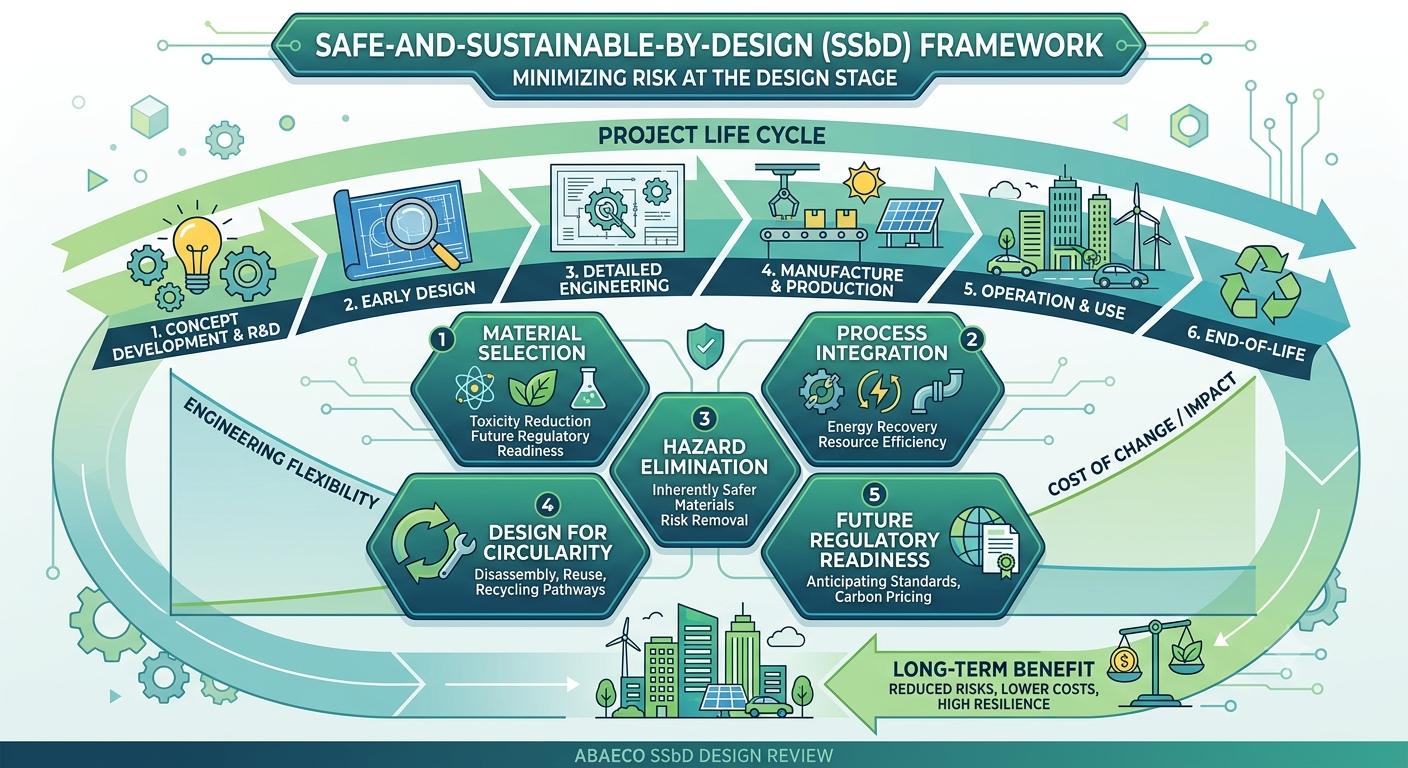
Safe-and-Sustainable-by-Design (SSbD) offers a useful framework for addressing sustainability risk proactively.
Rather than asking:
"How do we mitigate impacts after they occur?"
SSbD asks:
"How do we prevent those impacts from being embedded in the system in the first place?"
This requires engineers to consider multiple dimensions simultaneously:
Safety
Can hazards be eliminated rather than controlled?
Can inherently safer materials be used?
Can inventories be minimized?
Environmental Sustainability
Can energy demand be reduced?
Can renewable feedstocks be utilized?
Can life-cycle impacts be lowered?
Circularity
Can products be repaired?
Can materials be recovered?
Can components be reused?
Economic Performance
Will these choices remain viable under future market conditions?
Can resource efficiency improve competitiveness?
Operational Reliability
Will the system remain resilient under changing supply conditions?
Can process variability be managed effectively?
SSbD encourages engineers to treat these considerations as design drivers rather than compliance obligations.
Five Design Decisions That Significantly Reduce Sustainability Risk
1. Material Selection
Material choices influence toxicity, recyclability, supply security, and future regulatory exposure.
Selecting alternatives early can avoid substantial redesign costs later.
2. Process Integration
Energy recovery, heat integration, and optimized resource flows can significantly reduce operational impacts over the lifetime of a facility.
3. Hazard Elimination
Engineering out hazards is generally more effective than relying on monitoring systems, protective equipment, or administrative controls.
4. Design for Circularity
Products designed for disassembly, repair, remanufacturing, or component recovery retain value longer and support future circular business models.
5. Future Regulatory Readiness
Design decisions should anticipate evolving expectations related to chemicals, carbon intensity, resource efficiency, and product transparency.
The most resilient products are often those designed for regulations that do not yet exist.
Why Late Fixes Become Expensive
Organizations frequently underestimate how quickly flexibility declines as projects mature.
At the conceptual stage, modifying a design may require little more than additional engineering hours.
After procurement begins, changes affect suppliers.
During construction, redesigns can delay commissioning.
Once operations start, modifications may involve shutdowns, retrofits, and significant capital expenditure.
The same sustainability issue therefore becomes progressively more expensive to address over time.
This is one reason why leading organizations increasingly integrate environmental assessments, safety reviews, and circularity considerations into early-stage engineering processes.
They recognize that sustainability is not primarily an operational challenge.
It is a design challenge.
Engineers Are Becoming Strategic Decision-Makers
Historically, engineers were expected to optimize technical performance.
Today, their role is expanding.
They are increasingly expected to balance:
Safety;
Sustainability;
Circularity;
Regulatory uncertainty;
Supply chain resilience;
Economic competitiveness.
This transition requires broader decision frameworks and more integrated approaches.
Engineering decisions are no longer judged solely by whether systems function.
They are judged by whether systems remain viable under future environmental, regulatory, and market conditions.
Organizations that equip engineers with these capabilities will be better prepared to navigate uncertainty and maintain long-term competitiveness.
Final Thoughts
Many companies continue to approach sustainability as an exercise in impact reduction.
But by the time impacts are measured, many opportunities for meaningful improvement have already disappeared.
The most effective sustainability strategy is often the simplest:
Make better decisions earlier.
Engineers have a unique ability to influence outcomes before materials are purchased, facilities are built, products are launched, or risks become embedded.
Organizations that integrate safety, circularity, and sustainability at the design stage are not simply reducing environmental impacts.
They are reducing future costs, improving resilience, increasing regulatory readiness, and creating systems that are more likely to succeed in an increasingly resource-constrained world.
At ABAECO, this is the foundation of our SSbD Design Review approach: helping organizations identify where sustainability risks are being designed into systems—and where they can still be designed out before they become costly liabilities.