The Decision Bottlenecks Blocking Your Sustainability Progress
The biggest barrier to sustainability is rarely technology or regulation. It is the operational friction hidden inside everyday organizational decisions.
5/26/20263 min read
Why sustainability slows down long before implementation fails
Most companies think their sustainability problem is about:
budget
technology
regulation
data
or organizational resistance
But in many cases, the real issue is much simpler:
The organization cannot make sustainability decisions efficiently.
Not because people disagree with sustainability.
But because the decision system itself is fragmented, unclear, slow, or structurally misaligned.
This is where sustainability initiatives quietly stall:
not in strategy documents,
but inside operational bottlenecks.
Sustainability Is a Decision Flow Problem
Organizations often treat sustainability as:
a reporting function
a compliance layer
an ESG department
a communications initiative
But sustainability execution is actually a cross-functional decision process.
To implement real change, decisions must move across:
procurement
engineering
operations
finance
R&D
compliance
supply chain
executive leadership
And this is exactly where friction begins.
Because most organizations were not designed to make integrated sustainability decisions.
They were designed to optimize:
cost
speed
throughput
risk containment
departmental efficiency
Sustainability cuts across all of them.
Which means every initiative encounters organizational bottlenecks.
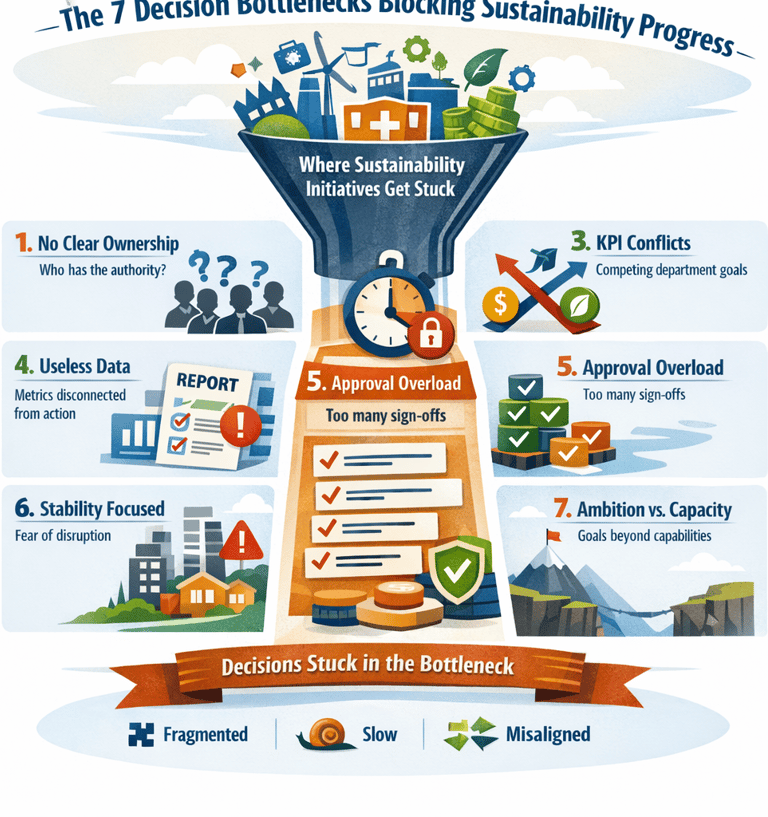
The 7 Decision Bottlenecks Blocking Sustainability Progress
1. Nobody Actually Owns the Decision
One of the most common failures is unclear decision authority.
The sustainability team may:
identify the issue
define targets
produce reports
propose initiatives
But they often cannot authorize:
process redesign
supplier changes
CAPEX allocation
operational adjustments
product modifications
At the same time:
operations, procurement, engineering, and finance may hold decision power but not sustainability accountability.
Result:
responsibility exists
authority does not
And initiatives stall between departments.
2. Sustainability Is Added Too Late
In many companies, sustainability enters after:
product design
process configuration
supplier selection
engineering decisions
commercial planning
At that stage, changing direction becomes expensive and politically difficult.
So sustainability becomes:
mitigation
compensation
reporting
offsetting
compliance adaptation
Instead of a design driver.
This creates a structural bottleneck:
the organization tries to optimize sustainability after core operational decisions are already locked in.
3. KPI Conflicts Freeze Decision-Making
Departments optimize different objectives:
procurement reduces cost
operations maximize throughput
finance protects margins
engineering minimizes delays
sustainability reduces impact
These goals often conflict.
And when no integrated decision framework exists, sustainability initiatives become trapped in endless internal negotiation.
The organization slows down because nobody wants to absorb the trade-off.
So decisions are postponed.
Or diluted.
Or abandoned quietly.
4. Sustainability Data Exists—But Is Operationally Useless
Many organizations have large volumes of ESG and sustainability data.
But operational teams often cannot use it in real decisions.
Why?
Because the data is:
disconnected from operational KPIs
too aggregated
too delayed
not linked to engineering variables
not integrated into investment models
This creates a dangerous illusion: -> leadership believes visibility equals control.
But reporting is not execution.
Without operational decision integration, sustainability data becomes informational rather than actionable.
5. Too Many Approvals Kill Momentum
Sustainability initiatives often require:
technical approval
financial approval
compliance approval
procurement alignment
executive sponsorship
operational validation
Each layer introduces delay.
Meanwhile, conventional operational decisions move much faster because governance structures already support them.
This creates organizational asymmetry:
the less familiar the sustainability initiative,
the harder the approval pathway becomes.
Eventually teams stop proposing ambitious changes altogether.
6. Operational Teams Are Measured Against Stability
Most industrial organizations reward:
predictability
uptime
efficiency
output consistency
risk minimization
But sustainability transitions often introduce:
process changes
new suppliers
material substitutions
redesign efforts
operational uncertainty
Operational teams therefore perceive sustainability as a threat to performance stability.
Not because they oppose sustainability,
but because the organization penalizes disruption more than it rewards transformation.
This is one of the largest hidden barriers to circularity and innovation.
7. Strategic Ambition Exceeds Organizational Capability
Many companies set sustainability goals faster than they build decision capacity.
The strategy evolves.
The organization does not.
This creates:
initiative overload
governance confusion
reporting fatigue
cross-functional conflict
execution paralysis
The company appears highly ambitious externally while internally struggling to coordinate decisions effectively.
The Real Cost of Decision Bottlenecks
When sustainability decisions stall, organizations experience:
delayed implementation
fragmented projects
weak cross-functional alignment
failed pilots
rising compliance pressure
operational inefficiency
innovation slowdown
employee frustration
Over time, this becomes a structural competitive problem.
Because companies that can integrate sustainability into operational decision-making will move faster than those trapped in internal friction.
Sustainability Failure Is Often Operational, Not Strategic
This is the key insight many organizations miss:
Most companies already know what they want to achieve.
The problem is:
they cannot operationally decide how to achieve it efficiently.
The bottleneck is not ambition.
It is decision architecture.
What High-Performing Organizations Do Differently
Organizations making real sustainability progress typically:
clarify decision ownership
align incentives across departments
integrate sustainability earlier into design and operations
simplify governance structures
connect ESG metrics to operational KPIs
reduce approval friction
enable cross-functional decision-making
Most importantly:
they treat sustainability as an operational system,
not a reporting exercise.
Final Thought
Sustainability rarely fails because companies lack strategies.
It fails because the organization cannot move decisions through the system fast enough, clearly enough, or coherently enough to execute them.
And until companies address the operational bottlenecks inside decision-making,
sustainability progress will continue slowing down long before implementation even begins.
Not because organizations do not care.
Because the system itself creates friction.
How Abaeco Helps
At Abaeco, we help organizations identify the operational and governance bottlenecks slowing sustainability execution.
Our Sustainability Decision Audit helps companies uncover:
decision friction points
KPI conflicts
governance gaps
cross-functional misalignment
operational barriers to sustainability integration
Because sustainable transformation depends not only on strategy—but on how decisions actually move through the organization.