Circular Economy Without Reverse Logistics Is Just Theory
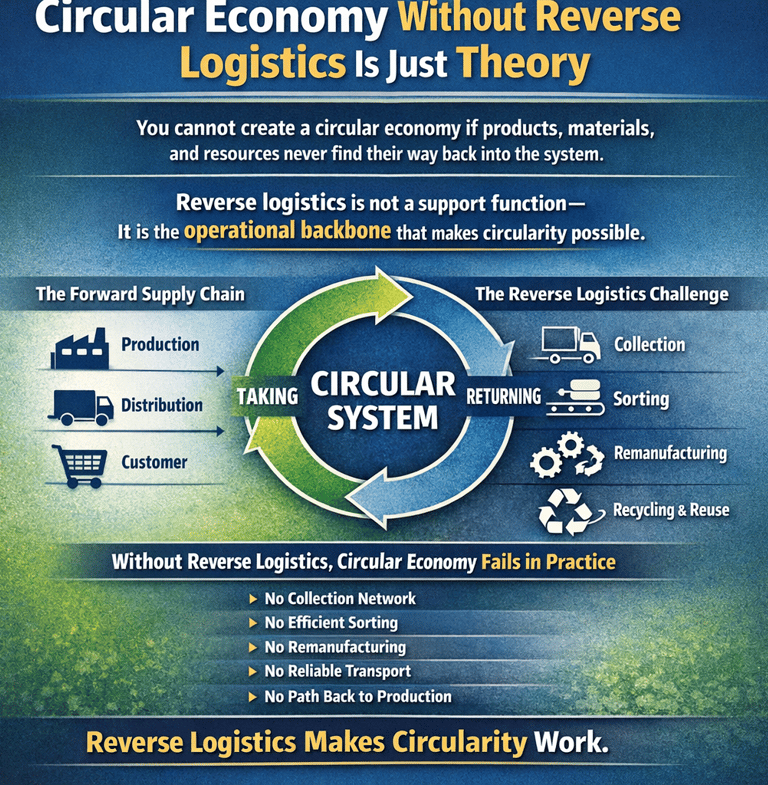
You cannot create a circular economy if products, materials, and resources never find their way back into the system. Reverse logistics is not a support function—it is the operational backbone that makes circularity possible.
6/16/20263 min read
Circular Economy Without Reverse Logistics Is Just Theory
Circular economy has become one of the most widely discussed concepts in sustainability and business transformation.
Organizations are investing in circular strategies, governments are promoting circular policies, and industries are exploring new ways to recover value from products and materials.
Yet despite growing interest, many circular economy initiatives never move beyond the concept stage.
Why?
Because companies focus on what happens to materials after use, but often overlook the system required to bring those materials back.
And that system is reverse logistics.
Without reverse logistics, circular economy remains an attractive theory with little practical impact.
The Missing Half of Circularity
Most organizations understand the forward supply chain.
Raw materials move through:
suppliers
manufacturing
distribution
customers
These flows are well designed, optimized, measured, and continuously improved.
Circular economy introduces a second challenge:
How do products, components, materials, and resources return after use?
That requires:
collection systems
transportation networks
sorting processes
inspection procedures
storage infrastructure
remanufacturing capabilities
reintegration into production
Without these capabilities, circular loops break immediately.
The material may still be recyclable in theory.
But in practice, it never comes back.
Why So Many Circular Initiatives Fail
Many circular economy projects begin with a promising idea:
reuse the product
recover the component
recycle the material
remanufacture the equipment
The environmental logic is often sound.
The engineering may even work.
But when implementation begins, reality emerges.
Questions appear:
Who collects the product?
Who pays for transportation?
Where is it stored?
Who inspects it?
How is quality verified?
How do we track ownership?
What happens if recovery volumes fluctuate?
These are not sustainability questions.
They are logistics questions.
And logistics determines whether circularity works or fails.
Circularity Is a Flow Problem
Many organizations think about circular economy as a materials problem.
In reality, it is a flow problem.
Materials only create value when they move through a functioning system.
A recycled material that cannot be collected has no value.
A reusable product that never returns is not reusable.
A remanufacturing process without a reliable supply of returned components cannot operate consistently.
Circularity depends on maintaining controlled flows across the entire system.
The moment those flows become unreliable, economic performance deteriorates rapidly.
The Cost Challenge Nobody Talks About
Reverse logistics is often significantly more complex than forward logistics.
In traditional supply chains:
materials move in predictable quantities
routes are optimized
destinations are known
demand is relatively stable
In reverse systems:
return volumes fluctuate
product quality varies
collection points are dispersed
transportation costs increase
contamination risks emerge
This is where many business cases collapse.
Companies discover that the environmental benefits exist, but the logistics costs outweigh the economic value recovered.
This does not mean circularity is impossible.
It means circularity must be designed as a system rather than an aspiration.
Why System Design Matters
The most successful circular business models are built around reverse logistics from the beginning.
They design products, operations, and supply chains together.
Questions are asked early:
Can products be easily recovered?
Is collection economically feasible?
Are recovery rates sufficient?
Can components maintain value after use?
Does the infrastructure exist?
Who owns the reverse flow?
These organizations recognize that circularity is not created by recycling technology alone.
It is created by the interaction between:
design
operations
logistics
economics
customer behavior
This is systems thinking in practice.
Reverse Logistics Creates Competitive Advantage
Companies that solve reverse logistics often discover benefits beyond sustainability.
They gain:
Greater Resource Security
Recovered materials reduce exposure to volatile raw material markets.
Better Supply Chain Resilience
Secondary material streams can reduce dependence on external suppliers.
Cost Reduction Opportunities
Recovering high-value components can lower production costs.
Regulatory Readiness
Future regulations increasingly require producer responsibility and material traceability.
Customer Retention
Take-back and recovery programs can strengthen long-term customer relationships.
In many industries, the reverse logistics capability itself becomes a competitive advantage.
The Circular Economy Reality Check
One of the biggest misconceptions in sustainability is that circularity automatically creates value.
It does not.
Circularity creates value when the system works.
And the system only works when products, materials, and resources can move efficiently in both directions.
A circular strategy without reverse logistics is like a manufacturing plant without a supply chain.
The concept exists.
The operation does not.
Final Thoughts
The future of circular economy will not be determined by sustainability ambitions alone.
It will be determined by operational capability.
Organizations that succeed will move beyond asking:
"Can this material be recycled?"
And start asking:
"Can this material be recovered, transported, sorted, processed, and reintegrated economically at scale?"
That is where circularity becomes real.
Because circular economy is not simply about keeping materials in use.
It is about designing systems that make their return possible.
And without reverse logistics, there is no circular system—only circular theory.